

Healthy Birth & Early Years
Why Birth and the Early Years are an important period
A child’s earliest years, from their birth to the time they reach statutory school age, are crucial. All the research shows that this stage of learning and development matters more than any other.
Unknown children – destined for disadvantage? – Ofsted33
Families are the most important influence on a child in the early years and identifying those families who need help as early as possible opens opportunities to offer evidence-based interventions. Several related protective factors can be optimised to support a healthy birth and the early years including:34
- Authoritative parenting combined with warmth, with an affectionate bond of attachment being built between
- the child and the primary caregiver from infancy
- Parental involvement in learning
- Protective health behaviours e.g. stopping smoking
- Psychological resources including self-esteem
- Breastfeeding
What is the Local Picture?
The most recently compiled and published data is compared with other local authorities of similar deprivation, unless stated otherwise, as of July 202135.
 Significantly worse than comparator Significantly worse than comparator |
 Not significantly different than comparator Not significantly different than comparator |
 Significantly better than comparator Significantly better than comparator |
 No IMD Decile Comparison No IMD Decile Comparison |
| Healthy Birth and Early Years Indicator | Previous period [Comparator IMD 2019] (Date) | Most recent available period [Comparator IMD 2019] (Date) |
|---|---|---|
| Breastfeeding initiation (%) | | |
| | 58.5 [74.0 England] (2015/16) | 80.4 [74.5 England] (2016/17) |
| Breastfeeding at 6-8 weeks (%) | | |
| | N/A | N/A |
| Low birth weight of all babies (%) | | |
| 8.1 [6.8] (2017) | 8.5 [7.2] (2018) | |
| A&E attendances aged 0-4 years (Rate per 1,000) | | |
| | 352.4 [560.5] (2017/18) | 373.3 [590.3] (2018/19) |
| Early Years Foundation Stage: good level of development at age 5 (%) | | |
| | 73.3 [N/A] (2017/18) | 73.3 [73.8] (2018/19) |
| Domestic abuse incidents (Rate per 1,000) | | |
| 15.1 [27.4, England] (2018/19) | 16.0 [28.0, England] (2018/19) | |
| Admissions for gastroenteritis in infants aged 1 year (Rate per 10,000) | | |
| 150.6 [93.8] (2018/19) | 125.1 [87.2] (2019/20) | |
| Admissions for lower respiratory tract infections in infants aged under 1 year (Rate per 10,000) | | |
| | 1,191 [686] (2018/19) | 981 [676] (2019/20) |
| Infant immunisations – MMR one dose at 24 months (%)* | | |
| | 90.9 [90.4] (2018/19) | 92.5 [90.4] (2019/20) |
| New-born Blood Spot Screening Coverage (%) | N/A | N/A |
| Hospital admissions for dental caries (0-5 years) (Rate per 100,000) | | |
| | 203.3 [209.0] (2016/17-18/19) | 201.3 [187.9] (2017/18-19/20) |
| Milton Keynes’s overall score for deprivation (using the 2019 Index of Multiple Deprivation) relative to all other local authorities in England, puts it in the 3rd least deprived decile. Throughout this report, Milton Keynes performance is compared to other areas of similar deprivation where possible. For comparison to other local authorities of similar deprivation (IMD 2015), please refer to the reference.36 Table Sources: Public Health Outcomes Framework: CYP JSNA – Section 2 (IMD 2019). [online] Available at: https://fingertips.phe.org.uk/indicator-list/view/wGGsClEvSk#page/0/gid/1/pat/10113/par/cat-113-8/ati/302/are/E06000042/iid/93580/age/309/sex/4/cat/-1/ctp/-1/yrr/1/cid/1/tbm/1 [Accessed 26 July 2021]. Public Health Outcomes Framework: CYP JSNA – Section 2 (IMD 2015). [online] Available at: https://fingertips.phe.org.uk/indicator-list/view/3bolzNZxDk#page/0/gid/1/pat/10039/par/cat-39-7/ati/102/are/E06000042/iid/93469/age/284/sex/4/cid/1/tbm/1 [Accessed 1 April 2021]. |

**Data quality issue: does not meet the minimum data quality standard of 95%
In summary, compared to other local authorities in the same deprivation decile, the data for Milton Keynes highlights the following:
- Significantly worse rates for low-birth weight of all babies, admissions for gastroenteritis in infants aged 1 year and admissions for lower respiratory tract aged under 1 year.
- Significantly better rates for A&E attendances for children aged 0-4 years compared with local authorities in the same deprivation decile and breastfeeding initiation (compared with England).
A Healthy Childhood
We are aiming for parents and carers to feel supported to make decisions to improve their child’s health outcomes and life chances, be their child’s first educator, and feel confident to manage their child’s minor illnesses and health issues.
The 0-5 year olds element of the Healthy Child Programme37 is led by the Health Visiting Service (managed locally by CNWL – Central & North West London NHS Trust), and involves integrated working with all partners across the system, including maternity services, children’s centres, Early Years settings, children’s social care, and GPs. It offers every family a programme of screening tests, developmental reviews, immunisations and guidance to support parenting and healthy choices until the child reaches statutory school age. In addition to universal services, the Healthy Child Programme provides additional support to families who need it to reduce the risk of adverse outcomes for the child.
Ensuring Children Are Ready to Learn
Improvements in development in the early years would be expected to have positive impacts on health, in both the short and long term, but also on education and social wellbeing throughout life. The early years (under 5s) framework aims for all children to be prepared and ready for school and for children starting school to reach the expected level of academic development, as well as personal, social and emotional development, physical, communication and language development.38
In 2018/19, 73.3% of children across Milton Keynes reported achieving a good level of development in the Early Years Foundation Stage; this is similar to local authorities in the same deprivation decile.
To support parents in their crucial role as their child’s first educator, evidence-based parenting programmes including ‘Just what we need’ and ‘Incredible Years’ are available in Children and Family Centres across Milton Keynes.
Development by 5 years
A child’s development, and a gauge of their readiness for school, is next measured at age 5, using the Early Years Foundation Stage profile (EYFSP).39 Improving the number of children who achieve a good level of development when starting school remains a priority for Milton Keynes.
Adverse Childhood Experiences and Trauma (ACEs)
Adverse Childhood experiences (ACEs) and Trauma40 are highly stressful, and potentially traumatic, events or situations that occur during childhood or adolescence.
These can be a single event, or prolonged threats to, and breaches of, a child or young person’s safety, security, trust or bodily integrity. These experiences directly affect the child or young person and their environment, and require significant social, emotional, neurobiological, psychological or behavioural adaptation. Adaptations are children and young people’s attempts to:
- Survive in their immediate environment
- Find ways of mitigating or tolerating the adversity by using available resources, establish a sense of safety or control, or to make sense of the experiences they have had
- Establish a sense of safety or control
- Make sense of the experiences they have had
What kinds of Experiences are Adverse?
There are a range of experiences that would be considered ‘adverse’ including:
- Maltreatment: including physical, sexual, emotional and financial abuse and neglect.
- Violence and Coercion: including experiencing, or directly witnessing, domestic abuse, assault, harassment or violence, sexual exploitation, sexually harmful behaviour, being the victim of crime or terrorism, experience of armed conflict, gang or cult membership and bullying.
- Adjustment: including moving to a new area where there are no social bonds, migrating, seeking and gaining refuge or asylum and the ending of a socially significant or emotionally important relationship.
- Prejudice: including discrimination, victimisation, hate incidents and crime, other attitudes, chronic exposure to behaviours and institutional processes driven by LGBT+ prejudice, sexism, racism or disablism.
- Household or family adversity: including living in a household with adults or adolescents who misuse substances, engage in criminal activities, are not supported to manage their mental ill health, making sense of intergenerational trauma (e.g. experiences of genocide). It also includes living in poverty, destitution or facing significant social, material and emotional deprivation. It also includes being looked after, leaving care, being detained in a secure children’s service (e.g. young offender institution) and family or placement breakdown.
- Inhumane treatment: including torture, forcible imprisonment, confinement or institutionalisation, nonconsensual and coercive scarification and genital mutilation.
- Adult responsibilities: including being the primary carer of adults or siblings in the family, taking on financial responsibility for adults in the household and engaging in child labour.
- Bereavement and survivorship: including death of care giver or sibling (including through suicide or homicide), miscarriage, acquiring or surviving an illness or injury, and surviving a natural disaster, terrorism or accident.
Often risk factors occur together; particularly children living in a family affected by the ‘toxic trio’ of parental mental illness, substance misuse and domestic violence. Over a quarter (26%) of babies in the UK, have a parent affected by at least one of these issues.41
Children and young people who witness and live with these stressful incidents are more likely to have low selfesteem, attachment issues and difficulties managing their emotions.
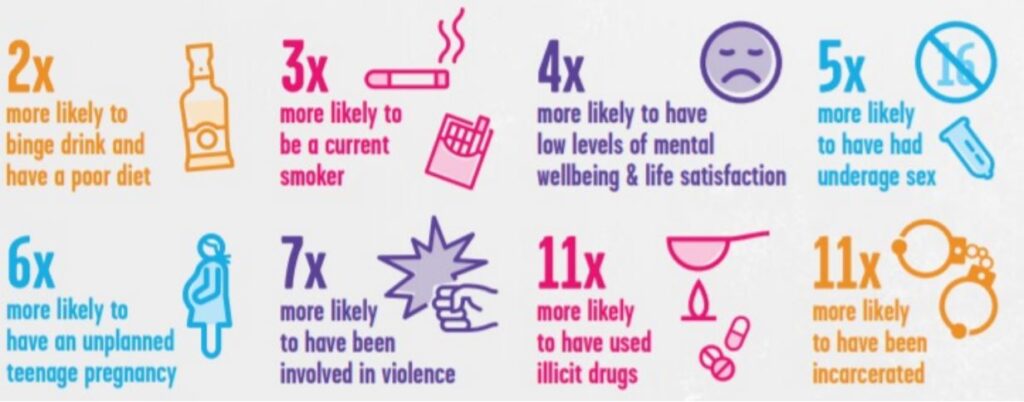
Individuals who experienced four or more adverse childhood experiences or traumatic events have an increased risk of high-risk behaviours and poorer outcomes as adults, as shown in the graphic below.42
Figure 1 : Adverse Childhood Experiences
Breastfeeding
Supporting families to breastfeed and increasing the number of babies who are breastfed gives babies the best possible start and considered a public health priority. There is extensive evidence on the breastfeeding benefits to mothers and their babies’ health, as well as evidence on how breastfeeding increases the level of attachment and bonding between mothers and their babies. The longer breastfeeding continues, the longer the protection lasts and the greater the benefits. The World Health Organization and the Department of Health recommend exclusive breastfeeding for the first six months of life.
Breastfed babies have lower rates of gastroenteritis, respiratory infections, sudden infant death syndrome, obesity and allergies. The health benefits for the mother include lower risks of breast and ovarian cancers, cardiovascular disease, osteoporosis and obesity in later life.
In Milton Keynes, 80.4% of new mothers’ initiate breastfeeding their babies, this is above the England average of 74.5%. In 2018/19, 1,941 mothers in Milton Keynes were still breastfeeding at 6-8 weeks after giving birth. Data for 2020 shows an increase in mothers who were breastfeeding at 6-8 weeks, which may be attributed to COVID and the associated lockdown.
Preventable Childhood Diseases
Antenatal and new-born screening is in place from pre-conception to 8 weeks after birth43 as part of the routine maternity care pathway across Milton Keynes. Through the robust programme provided locally, evidence suggests it can help prevent infection of the new-born child and ensure appropriate care is made available.
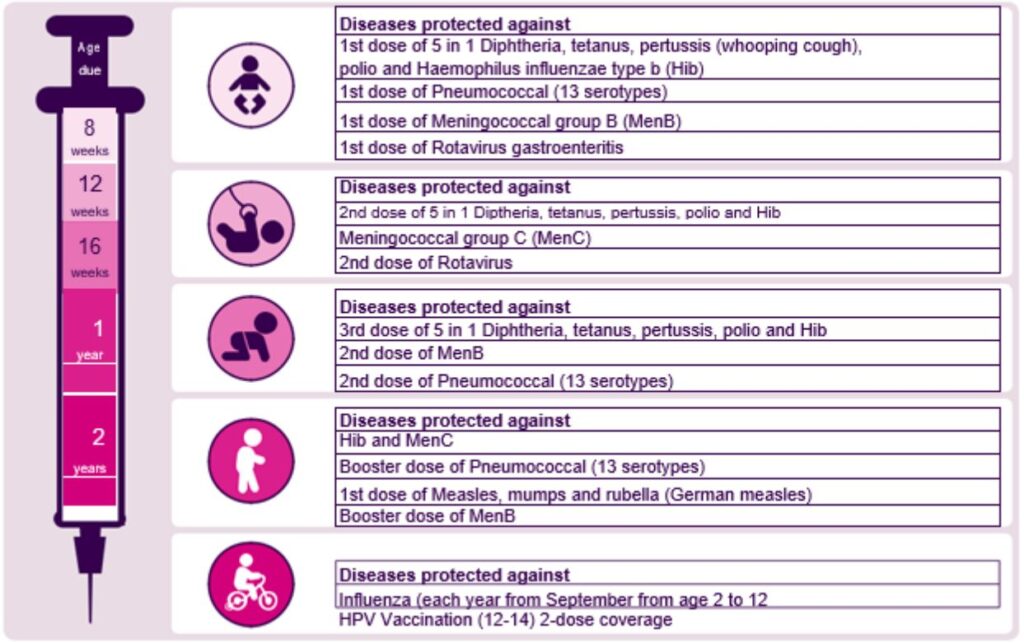
Vaccination is recognised as one of the most effective public health interventions, with the UK having one of the best immunisation programmes. High coverage protects the whole community, not just those vaccinated, by reducing the likelihood of infectious diseases being able to spread.
Research shows that children under the age of 5 years have the highest rate of hospital admissions of any age group. The purpose of the childhood vaccination programme is to help protect children against preventable diseases including measles, mumps and rubella.
The annual flu vaccination programme includes children; this helps to protect them from catching flu and to prevent spreading infection to their families and the wider community.
Across Milton Keynes, the 12-month indicator for Diphtheria/tetanus/Pertussis/Polio/Hib Influenza/Hepatitis B, Rotavirus, Pneumococcal and Meningitis B vaccines, are all above the England and East of England average for Q1-3 2020/21. Most vaccines types, other than Rotavirus, have, in Milton Keynes, sat consistently close to or above the national COVER target of 95%, even within the constraints of the pandemic. Sustaining uptake is very much attributed to the work of both General Practice and the support of the redeployed Community and School Age Immunisation team across Milton Keynes.
In relation to childhood vaccinations, Milton Keynes reached all national targets. The exceptions are for MMR at age 5 years (target of 95%) and HPV vaccination coverage for two doses for 13-14 years old females.44 However, between April 2019 and March 2020 the uptake in Milton Keynes of MMR remained statistically higher compared to others, with the first and second MMR dose reaching 89.7% of children aged 5 compared to 87.3% in local authorities in a similar deprivation decile.
Measles, Mumps and Rubella (MMR) vaccination is usually given in a combined vaccination at 12-13 months old with a booster after age 3yrs 4 months. This is particularly important to monitor, as measles can be fatal but uptake of MMR vaccinations continue to be affected by a public scare based on flawed scientific evidence. Strategies are in place with services that work across the Integrated Care System (ICS), NHSE and the Child Health Information Service, to improve uptake through targeted work, at practice level, for all children across MK with outstanding MMR vaccinations. Full uptake figures can be found in the COVER programme, 2020.45
Immunisation appointments have moved to children centres from April 2020. Although vaccination counts fell in March 2020 when physical distancing was introduced, it is now comparable to vaccination rates at this point in 2019 (before the pandemic).
The annual flu vaccination programme includes children; this helps to protect them from catching flu and to prevent spreading infection to their families and the wider community. For Bedfordshire, Luton and Milton Keynes (BLMK) CCG, flu vaccination uptake between April 20 and March 21 in Milton Keynes for the 2 & 3 year olds was on a par with both the England and East of England uptake and a significant improvement on 2019/20.
The NHSE Screening & Immunisation Team continue to update all members of the wider team, alongside Public Health, including 0-19 teams including Looked After Children teams, General Practice staff both clinical and nonclinical, pharmacists, Foster carers, Childminders and Early Staff on the changes in the UK Routine Vaccination Schedule, strategies on improving uptake, the role of Child Health Information Service and reducing inequalities.
Figure 2: Importance of immunisation for children & young people
Oral Health
Poor oral health can affect children’s ability to speak, eat, sleep, play and socialise and can negatively impact on a child’s school attendance and wellbeing. In the UK, tooth decay is still the most common cause of admission to hospital in 5-19 year olds. Our Oral Health Promotion (OHP) is embedded in a number of contracts (e.g. 0-19 and Children & Family Centres) which provide health education advice and information to parents and carers.
There is no discrete contract commissioned for oral health promotion. The current work is embedded within annual work programmes. At present this is an annual ongoing piece of work with Children & Family Centres, with the view that the oral health work is embedded as good practice, including local 0-19 health and wellbeing awards. Top Tips for teeth and other key promotional messages (e.g. Children and Family Centre tooth brushing sessions.46) are also cascaded by PH Practitioner (CYP) to the local Children’s Network, which has over 60 organisations/teams in it who work with CYP across Milton Keynes.
Reducing Emergency Hospital Attendances and Admissions
The main causes of A&E attendances and hospital admissions amongst children and young people are acute illnesses, such as gastroenteritis and upper respiratory tract infections, and injuries caused by accidents in the home particularly in the under 5’s. Unintentional injuries are the main cause of death in children and young people.
In the UK, one in 11 children has asthma, and every 20 minutes a child is admitted to hospital due to an asthma attack.47
Bedfordshire, Luton and Milton Keynes (BLMK) CCG has developed a systems approach to improving the
management of asthma in children and young people. This includes GPs, the 0-19 Healthy Child Programme service, schools and hospitals.
The impact of COVID-19 on a Healthy Birth and the Early Years
In Milton Keynes, there have been several changes to labour and post-natal services. This has been driven by the need to protect families during the pandemic there has been a reduction in postnatal midwifery and health visitor’s home visits. Although partners have been able to support women during their birth, it has also been necessary to reduce visitors to labour, antenatal and postnatal wards.
There have been increased demands on neonatal and paediatric services. During the initial wave of COVID-19, there was a requirement to protect mothers and babies by reducing visitors to their homes, and so much of the postnatal visiting by midwifery and health-visiting staff was changed to telephone or virtual consultation. Breastfeeding support leaflets were co-produced to enable women to access support when they needed it.
One of the major impacts of preterm deliveries is necrotising enterocolitis (NEC), a condition where intestines become inflamed and can lead to infection. Depending on the severity, neonates with NEC may require both neonatal services in maternity settings and surgical services in paediatric units.48 Studies have shown that breastmilk is one of the most effective ways to prevent or reduce the severity of NEC. Supporting breastfeeding provides an opportunity to promote neonatal health and it appears that during the pandemic more mothers were breastfeeding at 6-8 weeks. In order to sustain this unexpected improvement we need to understand why this increase has been seen.
In Milton Keynes, the Baby-Friendly Support team are continuing to encourage and support mothers in breastfeeding through virtual consultations. This has encouraged an increase in breastfeeding rates. To protect families during the pandemic, the well-baby health visitor clinic has stopped. In addition, there are concerns that with the increase in virtual support there is the potential to miss opportunities to identify babies who are failing to thrive, and to support those parents and families.49
The pandemic has influenced the development and well-being of children and young people. The largest impact is likely to fall on children from the poorest families or those with vulnerabilities and particular needs.50
In Milton Keynes, there has been partial closure of nurseries and face-to-face group activity in Children’s
Centres. During the course of the pandemic, there have been collaborative working between Children’s Centres, immunisation and maternity services to identify vulnerable or at-risk families earlier.
Changes to services have also caused some challenges due to the suspension of group activities. Children and families with complex home situations such as overcrowded housing or lack of play spaces are unable to access safe places to play and nurture positive social networks. These families may have some connections with children’s centres but not meet the threshold for other support organisations.
As in previous years, the majority of children will be offered a nasal spray as it is quick, painless and is more effective in children than an injectable vaccine. Children who cannot have the nasal spray because of pre-existing medical conditions or treatments may be offered an injected vaccine instead delivered either at school or by their GP practice.
The numbers attending vaccination clinics during March 2020 dramatically reduced, with the pandemic cited as a principal factor. In an effort to combat this, several changes were induced to ensure vaccination coverage for newborn babies, pregnant women and children under 1 year were not adversely affected.
Public Health England re-deployed the NHS providers of local school-aged immunisation service (SAIS) temporarily to support GPs by delivering immunisation services in the community. The local authority health protection team worked in collaboration with the NHS and early years and education teams within Bedford, Central Bedfordshire and Milton Keynes to secure community-based immunisation sites to reduce pressure on GP practices at the height of the pandemic between April and July 2020. Analysis of the results and impacts of the programme are expected in the coming months.
Priority areas we should continue to build on:
- Develop and retain our highly skilled and motivated 0-5 workforce across the system supporting integrated working across health, social care and education.
- Provide training for all professionals in Milton Keynes working with children and families to: recognise key risk factors (including adverse childhood experiences and trauma), improve information sharing, intervene early and refer to appropriate services.
- Support parents and carers to ensure their children are ready to learn. This includes increasing uptake of the integrated health and education review and free nursery places at 2 and 3 years where applicable.
- Ensure consistent messages across all health and early years providers to continue to promote and support responsive breastfeeding, responsive bottle-feeding and smoke-free environments.
- Reduce unintentional injuries in under 5s.
Priority actions to deliver better outcomes:
- The ICS/Public Health/NHSE and all key stakeholders in delivering vaccination to children and young people to work together to continually raise the profile of immunisation, monitor activity and identify and address issues such as increased vaccine hesitancy in certain communities, in a timely manner.
- Support with effective positive messages around immunisations to parents and young people.
- Using the most appropriate and effective means to communicate messages, for instance, social media and trusted voices.
- Support with access to appropriate community vaccination venues to provide easy access for all children who have not been vaccinated in a school setting.
- Population awareness of choice of vaccine for the healthy children’s flu programme to include non-porcine vaccine.
- Responsive 7-day services to cater to the needs of children and young people and carers to ensure children get care close to home at the right place at the right time.
- Continue to ensure a focus on identifying and addressing modifiable factors arising during reviews.
- Continue to ensure information about any child deaths reviewed that meet the criteria for a Learning
Disabilities Mortality Review are reported to and shared with LeDeR. - Monitor the palliative care pathway and promote support to bereaved families.
- Embed the use of the eCDOP system across the Milton Keynes workforce.
References
- Ofsted. 2016. Unknown Children – Destined For Disadvantage? [online] Available at: https://assets.publishing.service.gov.uk/government/uploads/system/
uploads/attachment_data/file/541394/Unknown_children_destined_for_disadvantage.pdf [Accessed 26 July 2021]. - Public Health England (2015). Promoting Children and Young People’s Emotional Health and Wellbeing. [online] https://www.gov.uk/government/publications/promoting-children-and-young-peoples-emotional-health-and-wellbeing [Accessed 29 April 2020].
- Public Health Outcomes Framework: CYP JSNA – Section 2 (IMD 2019). [online] Available at: https://fingertips.phe.org.uk/indicator-list/view/wGGsClEvSk#page/0/gid/1/pat/10113/par/cat-113-8/ati/302/are/E06000042/iid/93580/age/309/sex/4/cat/-1/ctp/-1/yrr/1/cid/1/tbm/1 [Accessed 26 July 2021].
- Public Health Outcomes Framework: CYP JSNA – Section 2 (IMD 2015). [online] Available at: https://fingertips.phe.org.uk/indicator-list/view/wGGsClEvSk#page/0/gid/1/pat/10113/par/cat-113-8/ati/302/are/E06000042/iid/93580/age/309/sex/4/cat/-1/ctp/-1/yrr/1/cid/1/tbm/1 [Accessed 1 April 2021]
- Department of Health (2009) The Healthy Child Programme. [online] Available at: https://www.gov.uk/government/publications/healthy-childprogramme-pregnancy-and-the-first-5-years-of-life [Accessed 13 January 2021]
- Department of Education Early Years – Ready to Learn. [online] Available at: https://www.education-ni.gov.uk/articles/early-years-education [Accessed 13 January 2021]
- Department of Education. Early years foundation stage profile handbook. Available at: https://www.gov.uk/government/publications/early-yearsfoundation-stage-profile-handbook [Accessed 12 May 2021]
- “Young Minds Addressing Adversity: Prioritising adversity and trauma-informed care for children and young people in England. Funded by Health Education England 2018”. [online] Available at: https://youngminds.org.uk/media/2142/ym-addressing-adversity-book-web.pdf [Accessed 25 January 2021].
- Wave Trust (2015). 1001 Critical Days. The Importance of the Conception to Age Two Period. [online] Available at: https://www.wavetrust.org/1001-criticaldays-the-importance-of-the-conception-to-age-two-period [Accessed 26 July 2021
- Young Minds 2020. Addressing Childhood Adversity and Trauma. [online] Available at: https://www.youngminds.org.uk/media/cmtffcce/ym-addressingadversity-book-web-2.pdf [Accessed 16 December 2020]
- Public Health England. 2020. Antenatal and New-born Screening Timeline – Optimum Times For Testing. [online] Available at: https://assets.publishing.service.gov.uk/government/uploads/system/uploads/attachment_data/file/768805/ANNB_Timeline_v8.4.pdf [Accessed 13 January 2021].
- (PHE), P., 2021. Public Health Profiles – PHE. [online] Fingertips.phe.org.uk. [online] Available at: https://fingertips.phe.org.uk/search/hpv#page/3/gid/1/pat/6/par/E12000008/ati/202/are/E06000042/iid/92896/age/296/sex/2/cid/4/tbm/1/page-options/car-do-0 [Accessed 25 May 2021].
- Public Health England. 2020. Cover of vaccination evaluated rapidly (COVER) programme: annual data. [online] Available at: https://www.gov.uk/government/publications/cover-of-vaccination-evaluated-rapidly-cover-programme-annual-data [Accessed 23 June 2021]
- Local.gov.uk. 2016. Tackling poor oral health in children. [online] Available at: https://www.local.gov.uk/sites/default/files/documents/tackling-poor-oralhealth-d84.pdf [Accessed 14 May 2021]
- Asthma UK. [online] Available at: https://www.asthma.org.uk/about/media/facts-and-statistics/ [Accessed 12 May 2021].
- Smith (2020). Impact of COVID-19 on neonatal health: Are we causing more harm than good? European Journal of Midwifery. [online] Available at: https://www.researchgate.net/publication/340609002_Impact_of_COVID-19_on_neonatal_health_Are_we_causing_more_harm_than_good [Accessed 11 January 2021].
- The Impact of the COVID-19 upon Children, Young People & Expectant Mothers: Phase 1, Hasna Dulfeker, Bedford, 2020.
- Sutton Trust. 2020. Covid-19 Impacts: Early Years – Sutton Trust. [online] Available at: https://www.suttontrust.com/our-research/coronavirus-impacts-earlyyears [Accessed 26 July 2021]