

Special Educational Needs
Special Educational Needs and Disabilities (SEND)
The full Special Educational Needs and Disabilities (SEND) Joint Strategic Needs Assessment was completed in 2024 and is shown below. It contains the following sections, which you can access quickly by clicking on the relevant button.
A PDF version of the Milton Keynes City SEND JSNA can be downloaded here
In addition, there are links to the local SEND offer, the SEND Strategy 2021-25 and the 2024 Action Plans.
Executive summary
The findings in this JSNA will be used by the Local Area Partnership to consider planning and delivery of services to children and young people with SEND in Milton Keynes.
In line with national trends and population growth in the area, the overall number of children and young people with SEND in Milton Keynes is increasing and there is an expectation that the population of children and young people with SEND could grow from 2022/23 numbers of around 7500 to approximately 11,000 by 2030.
Milton Keynes has a slightly lower proportion overall of children and young people identified with SEND overall than other areas, at 14.4% compared to 17.3% nationally. However there are variations between age groups, with rates of identified SEND key stage 3 in line with national, as opposed to key stages 1, 2 and particularly key stage 4 where rates are lower than national. Rates of EHCPs in Milton Keynes are growing more quickly than in other areas.
Boys are markedly more likely to be identified with SEND, as is the case across England. SEND may be identified slightly earlier in Milton Keynes than nationally, with SEND numbers peaking at age 9 compared to the national age of 10. The overall percentage of children with identified SEND declines through secondary school.
In the early years and reception, Speech, Language and Communication is the most commonly identified area of need in Milton Keynes, and the number of children identified with this area of need is increasing. There is a lower than national rate of Autistic Spectrum Condition identified in the year years, but this rate of identification increases in reception. The rate of Specific Learning Difficulties makes up a higher proportion of need in the early years than other parts of England.
Milton Keynes has a higher proportion of school-age children identified as having Autistic Spectrum Condition or Moderate Learning Difficulties as their primary need than in other areas of England. The gap is however closing in both cases, with identification of Moderate Learning Difficulties dropping in Milton Keynes to bring it closer in line with national rates, and Autistic Spectrum Condition increasing nationally which is bringing Milton Keynes in line with national numbers. Across all age groups, Milton Keynes has a lower proportion than other national areas of children and young people with SEND who are identified as having Social, Emotional and Mental Health needs as their primary area of need.
Inherent in the concept of inclusion is the need to reduce the impact of inequalities. In Milton Keynes and England overall, children from poorer backgrounds, as identified by eligibility to free school meals, are more likely to be identified with SEND than those who don’t have free school meals. They are more likely to have Social, Emotional and Mental Health issues as their primary need than any other. They are more likely to experience suspensions and exclusions than other groups.
In Milton Keynes, fewer than 50% of pupils are white British, which is lower than other areas in England and that proportion has reduced faster over time than England overall. In Milton Keynes there is a higher proportion of children of Black African origins with SEND than nationally and within this group the most often identified primary needs are very different from those for white British children. There is a greater identification of physical need, such as sensory impairments and speech and language issues, as opposed to specific learning difficulties and moderate learning difficulties.
The SEND Local Area Partnership will now consider each of the detailed areas in this JSNA in the delivery of their joint SEND strategy and commissioning activity.
Introduction
Why SEND is important
Every child in the UK is entitled to an education with the aim for them to achieve their potential through all stages of development – early years, at school (primary and secondary) and in further education settings, and to lead happy and fulfilled lives into adulthood. However, some children have needs that mean that this may not be possible without specific help that goes beyond standard education provision. It is therefore important to identify these needs and to develop services that provide the support necessary to meet them.
To achieve this, a combination of education, local authority and health services must form a local partnership to work together and importantly to work together with parents and the young people themselves.
Purpose of the Milton Keynes SEND JSNA
The Special Educational Needs and Disabilities (SEND) Joint Strategic Needs Assessment (JSNA) in Milton Keynes focuses on children and young adults aged 0-25 years who are residents of, or who are educated within, Milton Keynes.
The JSNA aims to provide Milton Keynes’ SEND Partnership Board, departments with responsibility for commissioning and service delivery and local leaders with an up to date understanding of the needs of local children and young adults with SEND to:
- Inform the strategic, system wide priorities to improve independence and outcomes for children and young adults with SEND, and their families,
- Inform commissioning at both strategic and operational levels, so that services and support are tailored to need and based upon the best available evidence
- Inform the wider system so that all relevant future plans in the local area are considered through the lens of independence and inclusion, reducing the social and environmental barriers to living with as much independence as possible.
Explaining SEND
Under Section 20 of the Children and Families Act 2014 and Section 312 of the 1996 Education Act, a child or young person has special educational needs (SEN) if they have a learning difficulty or disability that calls for special educational provision to be made for them. Children have a learning difficulty or disability if they:
- have a significantly greater difficulty in learning than the majority of others the same age
- have a disability that prevents or hinders them from making use of facilities of a kind generally provided for others of the same age in mainstream schools or mainstream post-16 institutions
- are under compulsory school age and fall within one of the definitions above or would do so if special educational provision was not made for them.
Special educational needs and disabilities (SEND) is an umbrella term that relates to a wide range of needs that can affect a child’s ability to learn in many different ways, including their:
- behaviour or ability to socialise, for example they struggle to make friends
- reading and writing
- ability to understand things
- concentration levels
- physical ability
How children with SEND are supported in schools
Many children and young people will experience barriers to learning or progress at some stage in their development. This can be for a range of reasons, and for many it will require only short-term provisions or support. The Graduated Response to SEND supports children and young people to have their needs identified and met at an early stage and with support appropriate to their needs. For some children and young people, their needs may be more enduring and may require a longer or more targeted intervention to support their ongoing progress. These children are described as having a special educational need and/or disability (SEND) and they may be supported through SEN support or through an EHC plan.
SEN support
Some children require extra or different help is given beyond that provided as part of the school’s usual curriculum. To aid this, the class teacher and special educational needs coordinator (SENCO) will implement support in school and may request advice or support from outside specialists.
Education, Health and Care (EHC) Plans
An education, health and care (EHC) plan is for children and young people aged up to 25 who need more support than is available through special educational needs support. EHC plans identify educational, health and social needs and set out the additional support to meet those needs. More details about SEND can be found on the UK government website Children with special educational needs and disabilities (SEND): Extra help – GOV.UK (www.gov.uk).
Mainstream Schools
The majority of children and young people with SEND (at SEND support or with an EHCP) are educated within mainstream schools, in their local area. Mainstream schools ensure that children and young people receive support and help in line with the graduated response to SEND or in line with the provision outlined on their EHCPs.
Resourced Provision and SEND Units in mainstream schools
A small percentage of children require access to specialist settings or more intensive support day to day, and these children may be educated in a Resourced Provision or a SEND unit in a mainstream school. Resourced Provisions are places that are reserved at a mainstream school for pupils with a specific type of SEND, taught mainly within mainstream classes, but requiring a base and some specialist facilities around the school. Resourced provisions:
- are designated by the local authority specifically for making this kind of SEN provision
- receive specialist funding from the local authority to deliver the appropriate service
- cater for a specific area or areas of SEN (for example specific learning difficulties)
- are usually for pupils with an education, health and care (EHC) plan
SEND units are special provisions within a mainstream school where the pupils with SEN are taught mainly within separate classes. They:
- are designated by the local authority specifically for making SEN provision, and sometimes accommodate pupils registered at other schools on a part-time basis
- receive specialist funding from the local authority to deliver the appropriate service
- cater for a specific type or types of SEN (for example autistic spectrum conditions)
Places in SEND Units are usually reserved for pupils with an education, health and care (EHC) plan. They may also provide support for pupils with SEN support.
Special schools
A small percentage of children with SEND will require access to a specialist school place, to support significant and enduring needs such as severe learning difficulties, moderate learning difficulties or social emotional and mental health. These:
- are registered as specialist settings
- receive specialist funding from the local authority to deliver the appropriate service
- ensure that the most vulnerable children in the area can access an appropriate education that is designed around their needs.
The local need
The number of pupils in Milton Keynes with both EHC plans and receiving SEN support increased from 6,354 in the 2015/16 academic year to 7,567 in 2022/23. However, the increases were markedly different between the two categories of SEND provision. The number of pupils with EHC increased 43% at a compound annual growth rate (CAGR*[1]) of 5.26% over the seven-year period, primarily driven by double digit growth in the two years affected by the pandemic. In contrast, the number of pupils receiving SEN support reduced in 2020/21 with school closures, leading to a lower overall increase between 2015/16 and 2022/23 in numbers of 13% at a CAGR of 1.72%.
Table 1: Number of children and young people by SEND provision type, 2015/16-2022/23
| Type of support | 2015/16 | 2016/17 | 2017/18 | 2018/19 | 2019/20 | 2020/21 | 2021/22 | 2022/23 |
|---|---|---|---|---|---|---|---|---|
| EHC Plan (number of pupils) | 1,368 | 1,389 | 1,400 | 1,415 | 1,580 | 1,721 | 1,858 | 1,958 |
| SEN support (number of pupils) | 4,986 | 5,308 | 5,336 | 5,394 | 5,560 | 5,207 | 5,554 | 5,618 |
| Total special educational needs | 6,354 | 6,697 | 6,736 | 6,809 | 7,140 | 6,928 | 7,412 | 7,576 |
| Total pupils | 46,584 | 47,696 | 48,272 | 48,815 | 49,576 | 49,784 | 51,050 | 52,457 |
In comparison to England, the percentage of school pupils with an EHC plan in place is similar, however the percentage of pupils receiving SEN support is lower in Milton Keynes.
Table 2: Percentage of children and young people by SEND provision type, 2015/16-2022/23
| 2015/16 | 2016/17 | 2017/18 | 2018/19 | 2019/20 | 2020/21 | 2021/22 | 2022/23 | ||
|---|---|---|---|---|---|---|---|---|---|
| Milton Keynes | % of pupils with EHC plan | 2.9 | 2.9 | 2.9 | 2.9 | 3.2 | 3.5 | 3.6 | 3.7 |
| % of pupils with SEN support | 10.7 | 11.1 | 11.1 | 11.0 | 11.2 | 10.5 | 10.9 | 10.7 | |
| England | % pupils with EHC plan | 2.8 | 2.8 | 2.9 | 3.1 | 3.3 | 3.7 | 4.0 | 4.3 |
| % pupils with SEN support | 11.6 | 11.6 | 11.7 | 11.9 | 12.1 | 12.2 | 12.6 | 13.0 |
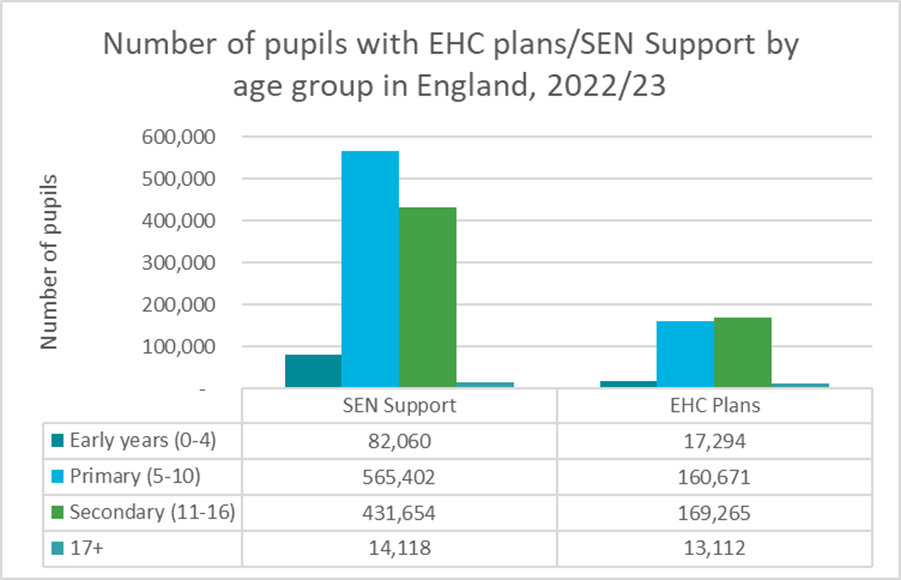
SEN is more prevalent in boys than girls. In Milton Keynes, boys account for 73.6% of pupils with EHCP and 65.6% of pupils with SEN support but no EHCP. This compares to 72.4% and 62.8% nationally. Nationally, EHCP/SEN is most prevalent at age 10 (21% in 2022/23) then declines through secondary ages, down to 10% at age 16.
Figure 1: The percentage of pupils with SEN support in England peaks at age 5-10 (Primary School)
Milton Keynes follows very similar trends.
Figure 2: The percentage of pupils with SEN support peaks at age 5-10 (Primary School), Milton Keynes:
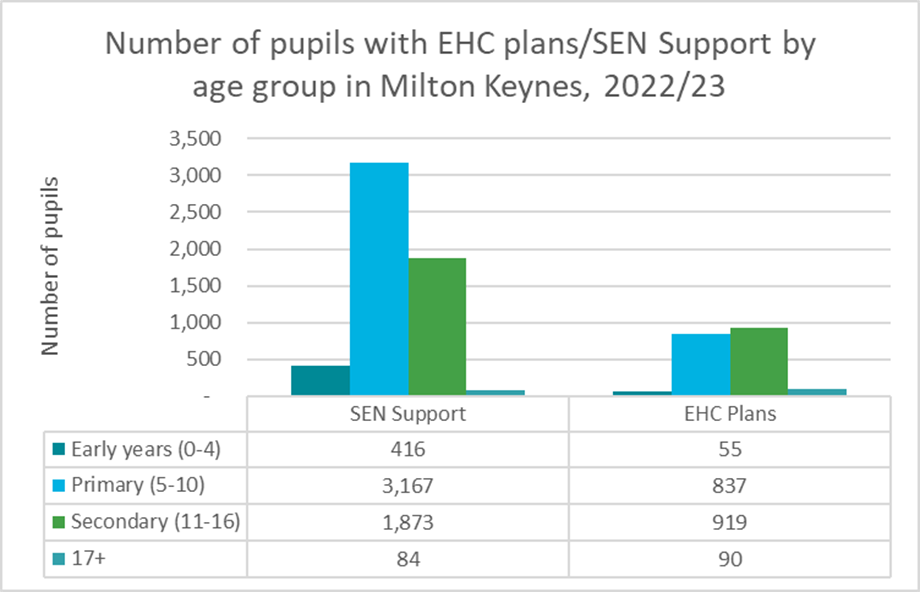
Please note: this analysis and all that follows does not include data from Independent Schools (78 pupils receiving SEN Support and 57 with EHC plans) and therefore does not equal the total number in table 1. The total number is 7,441.
The need for all SEN is greatest in primary schools and declines in secondary school. More pupils receive SEN support in primary schools than have EHC plans, but there are more pupils with EHC plans in secondary schools than in primary schools. The number of pupils with EHC plans also increases from primary to secondary schools, whereas the number receiving SEN support decreases, reflecting the different nature of the needs.
Primary need
The primary need refers to the main reason that a child requires additional help to learn and develop to meet their potential. There are currently 13 primary needs identified and recorded by education settings. Some children’s needs will fit under one heading, such as a blind child with no other conditions or disabilities, whereas others will cross multiple areas, such as an autistic child with sensory issues and learning disabilities. It’s also important to understand that while some children will always have SEN, others have shorter term needs that once met will mean that standard education provision will be sufficient for the child to learn and thrive.
The 13 needs fall under four broad areas.
Communication and Interaction
Children and young people with speech, language and communication needs (SLCN) have difficulty in communicating with others. This may be because they have difficulty saying what they want to, understanding what is being said to them or they do not understand or use social rules of communication. The profile for every child with SLCN is different and their needs may change over time. They may have difficulty with one, some or all areas of the different aspects of speech, language or social communication at different times of their lives.[2]
Speech, Language and Communications Needs
Pupils with SLCN cover the whole ability range. They may have difficulty in understanding information conveyed through spoken language and they find it hard to understand and/or use words in context in their native language. This is distinct from children whose first language is not English and children with language difficulties related to English as a second language should not be included in this category.
Autistic Spectrum Condition
Autistic Spectrum Condition is a spectrum and affects children very differently. Autism is identified as an SEN when it leads to significant difficulties in the areas of social communication, social interaction, and restricted and repetitive patterns of behaviour/interests.
Cognition and Learning
Learning Difficulties
Learning difficulties is another umbrella term and it can be specific, affecting one aspects of learning or affect multiple aspects and it varies in severity. It includes where children and young people learn at a slower pace than others their age, have difficulty in understanding parts of the curriculum, have difficulties with organisation and memory skills, or have a specific difficulty affecting one particular part of their learning performance such as in literacy or numeracy.
Specific Learning Difficulties include conditions such as dyslexia, dyspraxia and attention deficit hyperactivity disorder (ADHD). Children can be identified as having SEN within this category without a formal diagnosis.
Moderate Learning Difficulties – This includes pupils with generalised learning difficulties across all curriculum areas and includes difficulties in adaptive functioning such as communication, social skills, independence and self-care. (IQ between 50 and 70).
Severe Learning Difficulties – Children with these needs have significant learning difficulties that mean they achieve less than 50% of age group targets across all areas of education, including adaptive behaviour. (IQ less than 50).
Profound and Multiple Learning Difficulties – In addition to severe learning difficulties, pupils will have other significant difficulties, including physical difficulties, sensory impairment(s) and/or severe medical difficulties. Pupils with PMLD are likely to need sensory stimulation and a curriculum broken down into very small steps.
Social, emotional and mental health
Children can have social, emotional and mental health difficulties at any stage in their development and these can be linked to a specific event in their lives, such as bereavement, trauma, illness, family stresses and being bullied. The presenting problems, therefore, can vary in intensity, frequency and duration. Children and young people with social, emotional and mental health difficulties often have difficulty in managing their relationships with other people, are withdrawn, or if they behave in ways that may hinder their and other children’s learning, or that have an impact on their health and wellbeing. Social, emotional and mental health becomes an SEN when the impact of emotional responses has a significant and enduring impact on learning.
They may range from changes in emotional resilience (such as withdrawal or anxiety about attending school/setting) to expressions of underlying stress (such as tearfulness, refusal to engage with learning, self-harming) or more overtly challenging behaviour (such as aggression, defiance, anti-social acts). Some emotional and mental health needs can be linked to longer term issues such as learning problems, difficulties with social skills, prolonged family disruption or medical conditions such as Autism Spectrum Condition (ASC) or Attention Deficit Hyperactivity Disorder (ADHD), which may become identified as the primary need.
Sensory and/or Physical
Some children and young people require special educational provision because they have a disability which prevents or hinders them from accessing and making full use of the educational facilities generally provided. This category includes:
- Visual impairments, from partial sight through to blindness. Pupils with VI may require adaptations to their environment and/or different learning materials
- Hearing impairments, from mild hearing loss to profound deafness
- Multi-sensory impairment (MSI) – visual and hearing impairments combined
- Physical disabilities that require on-going support
Primary need prevalence
In 2022/23 the most common primary needs identified in Milton Keynes were: speech, language and communication needs (25%), a moderate learning disability (20%), autistic spectrum condition (17%) and social, emotional and health needs (14%). The percentage of children with speech, language and communication needs was similar to England (24%). However, across the country overall, the second largest primary need identified was social, emotional and mental health (20%), while moderate learning disability was third ranked with 15%. This means that Milton Keynes had a considerably higher proportion of SEN children identified with moderate learning disability as their primary need in 2022/23.
However, all SEN (Support and EHC plans) peaks a year earlier at age 9 (19% of all pupils) (See figure 2). The last SEND inspection (Ofsted/CQC) of Milton Keynes SEND partnership (October 2018), highlighted that a higher-than-expected percentage of children were being assessed as having Moderate Learning difficulties as their primary need. However, both the Milton Keynes and England trends are downward and, if they continue, 12% of children with SEN in Milton Keynes will have moderate learning difficulties identified as their primary need in 2030, closing the gap to England where the proportion is estimated to be 10%.
Table 3: Number of children and young people receiving SEN provision in Milton Keynes by primary need, 2015/16 -2022/23
| Primary need | 2015/16 | 2016/17 | 2017/18 | 2018/19 | 2019/20 | 2020/21 | 2021/22 | 2022/23 |
| Autistic Spectrum Condition | 572 | 622 | 693 | 822 | 933 | 1006 | 1100 | 1268 |
| Hearing Impairment | 130 | 145 | 160 | 165 | 164 | 160 | 155 | 168 |
| Moderate Learning Difficulty | 2056 | 1964 | 1893 | 1800 | 1765 | 1619 | 1593 | 1463 |
| Multi- Sensory Impairment | 9 | 10 | 9 | 9 | 13 | 12 | 14 | 18 |
| Other Difficulty/Disability | 214 | 378 | 355 | 305 | 361 | 317 | 263 | 276 |
| Physical Disability | 105 | 102 | 106 | 113 | 108 | 103 | 114 | 129 |
| Profound & Multiple Learning Difficulty | 48 | 50 | 53 | 48 | 57 | 58 | 48 | 52 |
| SEN support but no specialist assessment of type of need | 321 | 316 | 245 | 221 | 189 | 181 | 246 | 252 |
| Severe Learning Difficulty | 84 | 88 | 100 | 102 | 99 | 107 | 104 | 129 |
| Social, Emotional and Mental Health | 945 | 966 | 986 | 1000 | 1081 | 982 | 1060 | 1043 |
| Specific Learning Difficulty | 608 | 638 | 636 | 627 | 697 | 636 | 764 | 673 |
| Speech, Language and Communications needs | 1138 | 1272 | 1338 | 1437 | 1518 | 1589 | 1758 | 1897 |
| Visual Impairment | 74 | 71 | 69 | 66 | 63 | 62 | 66 | 73 |
| Grand Total | 6,304 | 6,622 | 6,643 | 6,715 | 7,048 | 6,832 | 7,285 | 7,441 |
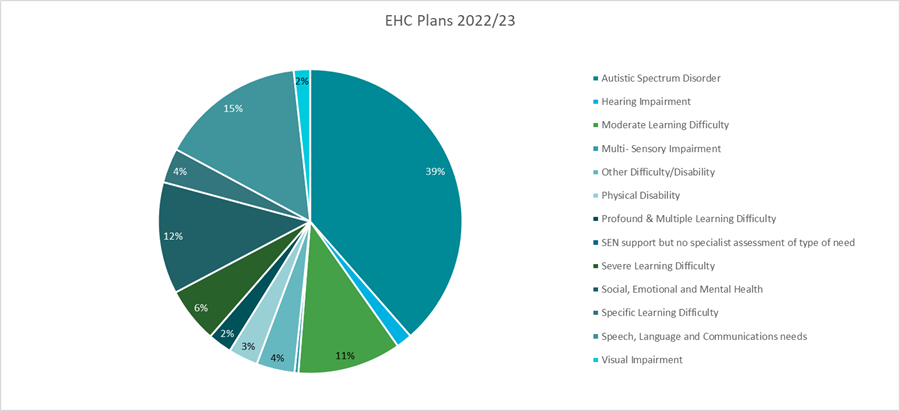
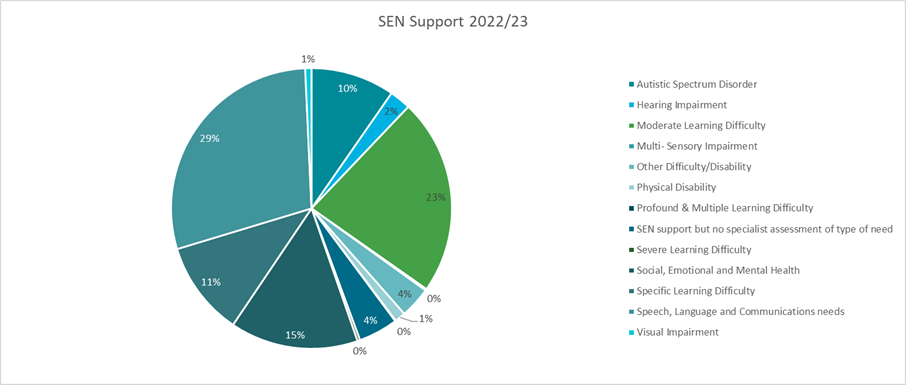
The largest primary need for children with an EHC was from autistic spectrum condition (ASC) (39% of children with EHC), whereas children with ASD account for 10% of the children receiving SEN Support. The proportion of EHC children with ASD as a primary need in Milton Keynes was higher in 2022/23 than for England overall, where children with ASD accounted for 32% of all those with an EHC in 20222/23 and 8% of those receiving SEN Support. If the current trends continue in both England and Milton Keynes, then the proportion of children in Milton Keynes with an EHC with ASD as their primary need will be closer to the England average in 2029/30, 38% compared to 35% but gap for SEN Support will widen from 1 percentage point to 3.
Figure 3: Percentage of children in MK receiving SEN provision by type and primary need, 2022/23
thehehehe
Early Years
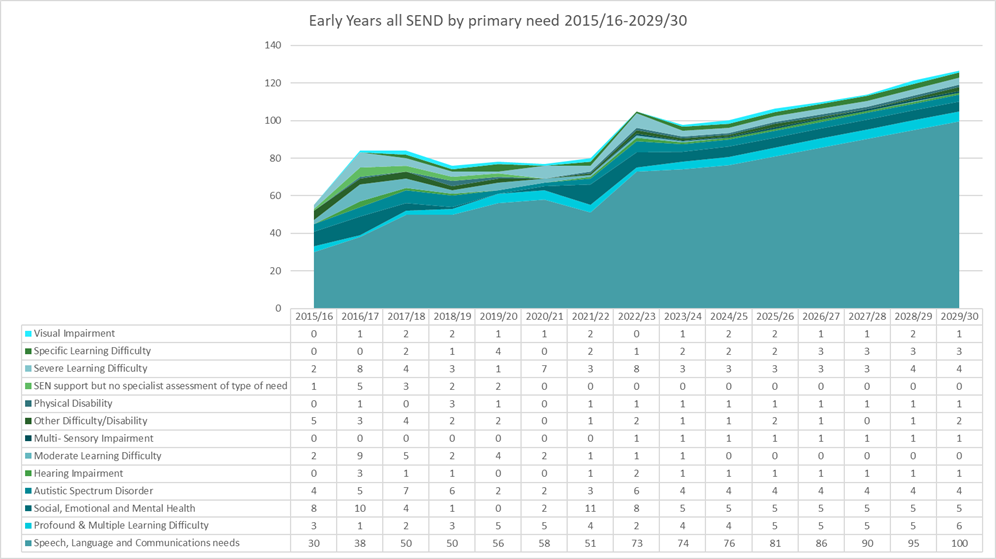
In 2022/23, 105 children aged 4 and under were identified with SEND of which 7 had EHC plans and 98 received SEN Support.
Speech, Language and Communication needs is by far the largest area of primary need for children aged 4 and under and it accounted for 69.5% of all SEND (EHCP and SEN Support) identified in this cohort. This is in line with England (65.2%). However, in Milton Keynes specific learning difficulties account for a higher proportion of needs (7.6%) identified than in England (1.7%), while Autistic Spectrum Condition (ASC) has a lower proportion – 5.7% in Milton Keynes compared to 9.6% for England. It is important to recognise that the numbers involved are very small (single figures) and therefore trends for many needs cannot be identified. However, the number of children with Speech, Language and Communication needs identified as the primary need has increased rapidly since 2015/16, rising at a CAGR of 13.5% from 2015/16 to 2022/23. If the trend continues by 2030, there will be 100 children aged 4 and under with recognised speech, language and communication needs, 99 of whom would require SEN Support and one an EHC plan.
Figure 4: Number of children receiving SEN provision by primary type in Early Years
Impact of COVID-19 and recovery
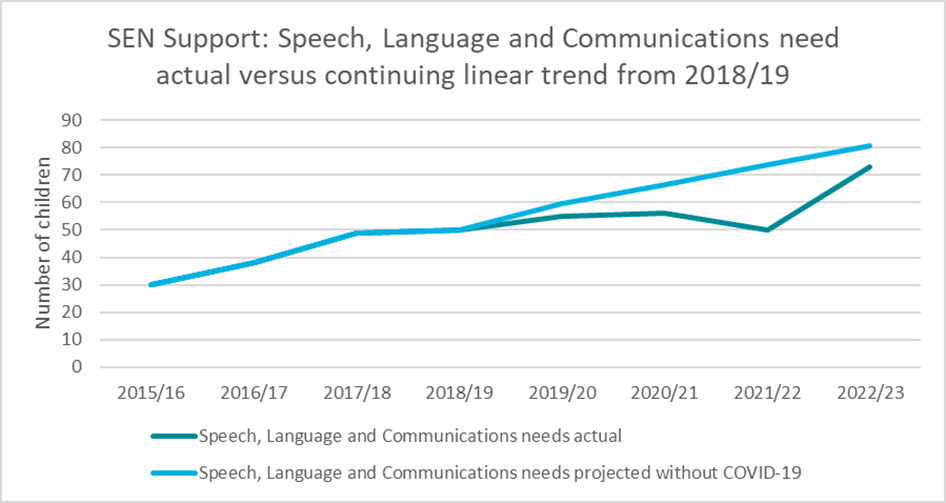
It is not possible to define the impact of COVID-19 restrictions from the data among children with an EHC plan as the numbers are so small. However, among those receiving SEN Support there was a noticeable drop in the number of children with both Social, Emotional and Mental Health and Speech Language and Communications as their primary need. In both instances, there has been a recovery in numbers towards the pre-COVID-19 trend, however, there remain more children with Social, Emotional and Mental Health needs and fewer with Speech Language and Communications needs identified than would have been expected had there not been a pandemic.
Figure 5: The Impact of COVID-19 on Social, Emotional and Mental Health needs provision in Early Years
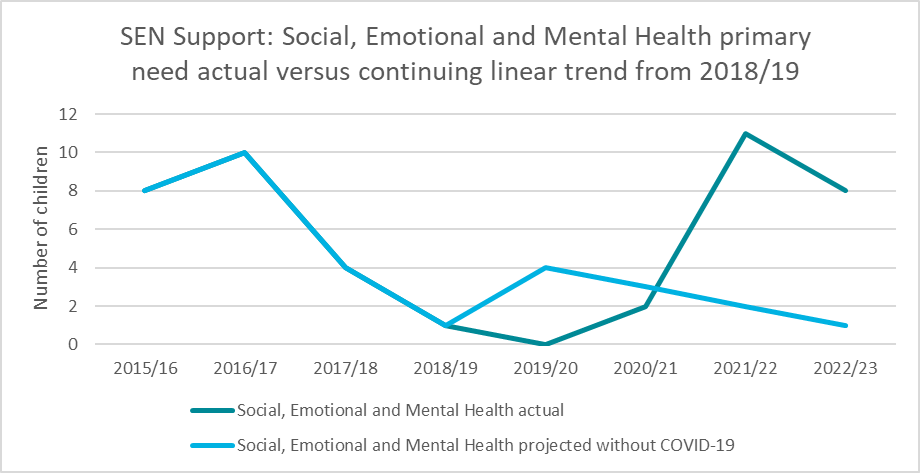
Figure 6: The Impact of COVID-19 on Speech, Language and Communications needs provision in Early Years
thehehehe
Reception
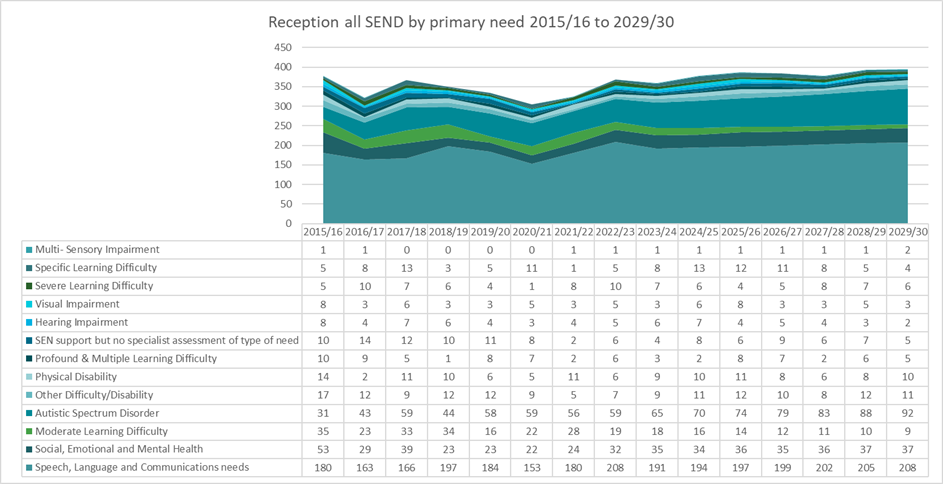
In 2022/23, the total number of children with SEND in reception in Milton Keynes was 369, with 320 children receiving SEN Support and 49 with an EHC plan in place. In total 10.0% of pupils in reception were identified with SEND, compared to 11.9% in England.
As was the case in the early years, the most identified primary need was Speech, Language and Communication, accounting for 56.4% of SEND children. The equivalent in England was 54.5%.
However, the proportion of children with SEND with Autistic Spectrum Condition as a primary need (16%) was markedly greater than in the early years and accounted for a higher proportion of all SEND needs identified than the equivalent in England (14.7%). The majority of this need was being met with SEN Support in 2022/23. The number of pupils being identified with Autistic Spectrum Condition in Reception across Milton Keynes rose at a CAGR of 9.6% from 2015/16 to 2022/23, which is in line with England overall (9.1%). If the trend were to continue, there would be 92 pupils with Autistic Spectrum Condition identified as a primary need in 2030.
Figure 7: The number of children receiving SEND provision by primary need in Reception, 2015/16-2029/30
Impact of COVID-19 restrictions and recovery
There was no noticeable impact on the number of children with an EHC plan between 2019/20 and 2021/22, although the small numbers make analysis difficult. For children receiving SEN Support, there was a noticeable change in numbers between 2019/20 and 2020/21 for Social, Emotional and Mental Health and Speech, Language and Communications Needs and, as was the case in the Early Years, both were recovering towards the total historic trend.
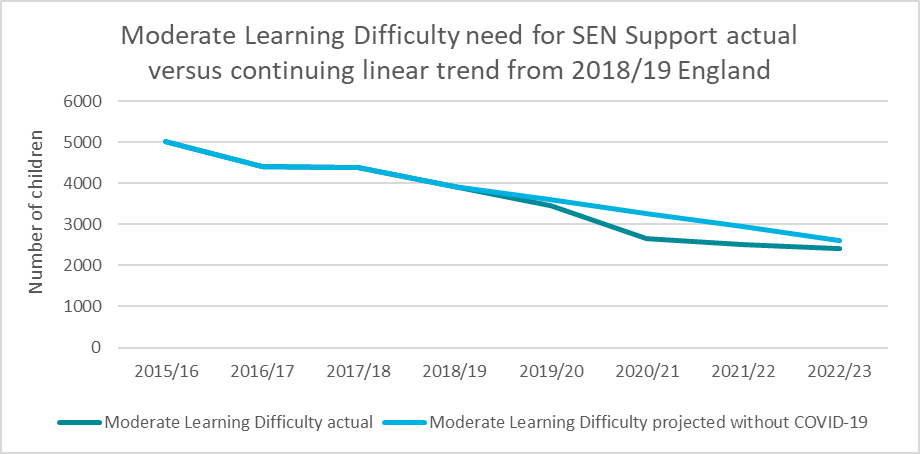
In addition, restrictions appear to have impacted on the number of children with Moderate Learning Difficulties as a primary need receiving SEN Support. In this instance after a recovery in 2021/22 following the national trend, there was another reduction in the number of children receiving SEN Support for Moderate Learning difficulties, suggesting that there may be influences on this number in Milton Keynes beyond COVID-19.
Figure 8: The Impact of COVID-19 on Moderate Learning Difficulty SEN Support provision in Reception in Milton Keynes
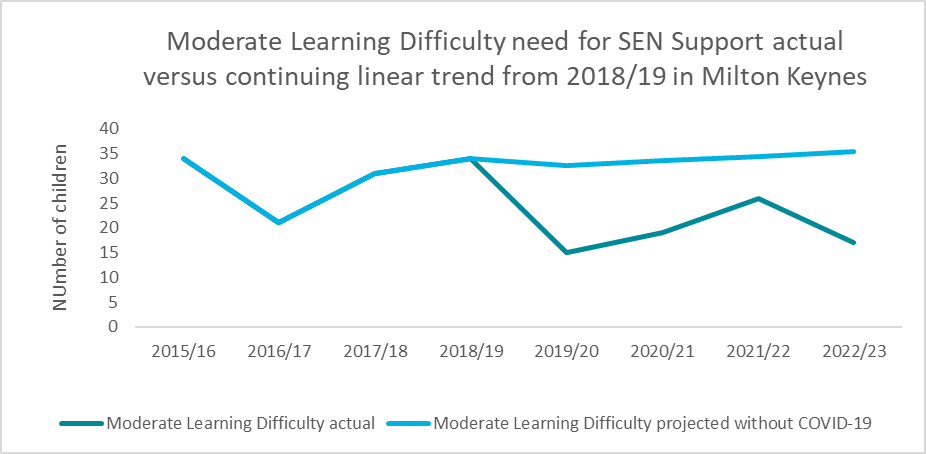
Figure 9: The Impact of COVID-19 on Moderate Learning Difficulty SEN Support provision in Reception in Milton Keynes
vthtvvv
Key Stage 1 (Years 1-2)
In 2022/23, the number of children with SEND in Key Stage 1 in Milton Keynes was 1,331, with 929 children receiving SEN Support and 202 with an EHC plan in place. In total 14.8% of pupils in KS1 were identified with SEND, compared to 16.0% in England.
ASD was the primary need most identified for children with an EHC plan by Key Stage 1, accounting for 42% of all the children with EHC plans in 2022/23. Of all children with ASD identified as their primary need, more received an EHC plan (60%) than SEN Support (40%). This is in line with 2018 research suggesting that over 50% of people receive their first autism diagnosis before the age of 10[1] in England. Since 2015/16, the number of pupils in MK with ASD as a primary need who have an EHC plan has increased at a CAGR of 5.7%. This is following the same trend as England but at a slower rate (England CAGR 10.9%).
In contrast, the rate of increase in the number of children with ASD as their primary need who received SEN Support was much higher in Milton Keynes (12.2%) than in England overall (7.1%).
In 2022/23, the three largest groups receiving SEN support in Key Stage 1 were children with a primary need of: Speech, Language and Communication; Moderate Learning Difficulties and Social, Emotional and Mental Health, the same as for England overall. Generally, the characteristics of these groups are in line with England, however, children with a primary need of Moderate Learning Difficulties in Milton Keynes accounted for a higher proportion of children receiving SEN Support and of all pupils than in England overall and while the numbers are declining, they are doing so at a slower rate than England overall.
Table 4: KS1 Percentages and growth of three largest groups receiving SEN Support (Milton Keynes and England)
| Primary Need | MK number of children | MK %age of SEN Support | England %age of SEN Support | MK %age of all children (SEND and no SEND) | England %age of all children (SEND and no SEND) | MK Rate of change 2015/16- 2022/23 (CAGR) | England rate of change 2015/16- 2022/23 (CAGR) |
|---|---|---|---|---|---|---|---|
| Speech. Language and Communication | 453 | 48.6% | 47.9% | 5.9% | 6.0% | 3.7% | 3.8% |
| Moderate Learning Difficulties | 169 | 18.2% | 12.2% | 2.2% | 1.5% | -5.7% | -7.9% |
| Social, Emotional and Mental Health | 112 | 12.1% | 17.0% | 1.5% | 2.1% | -3.7% | 2.1% |
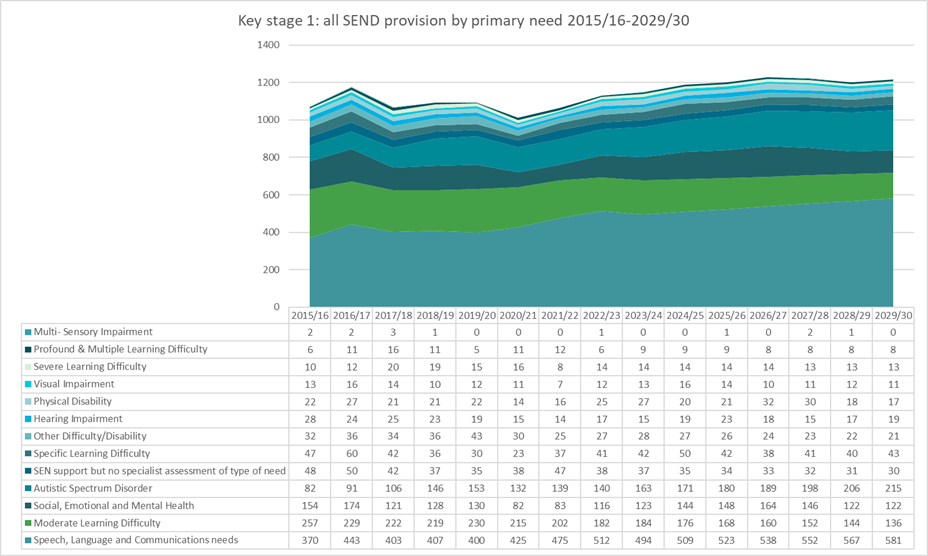
If the trends continue, the number of children in KS1 receiving any form of SEN provision will drop 271 from 2022/23 levels to 1,060 in 2029/30, despite an increase in EHC provision. That reduction would be driven by a reduction in the overall school population in KS1 as the proportion of children receiving SEND provision remains constant. However, within this, there are downward trends in the number of children with Moderate Learning Difficulties, Social, Emotional and Mental Health needs and Specific Learning Difficulties receiving SEN Support.
Figure 10: Projection of all SEND provision by primary need to 2029/30 in KS1
Impact of COVID-19 restrictions and recovery
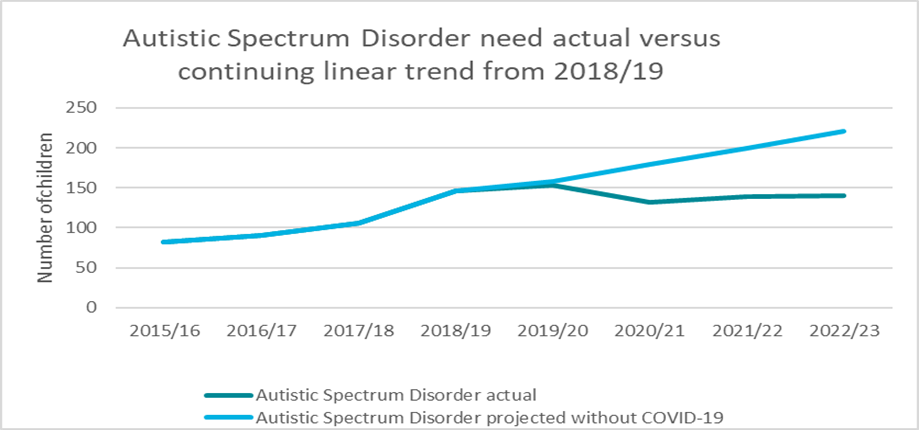
After continuously growing from 2015/16 to 2019/20, the number of children with ASD as their primary need in KS1 who received SEND provisions decreased between 2019/20 and 2020/21. The numbers have not yet recovered to the numbers that would have been expected if the pre-COVID-19 rate of increase had continued. The gap equates to 80 children.
Figure 11: The Impact of COVID-19 on ASD need provision in KS1
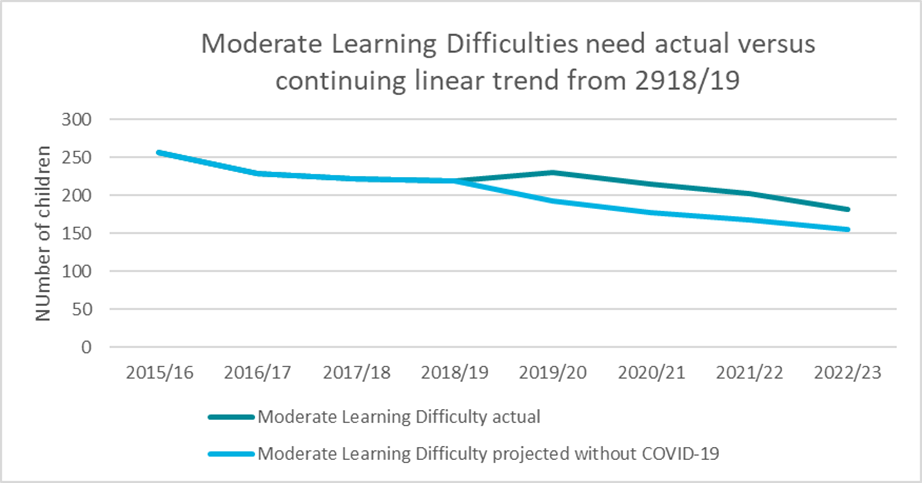
The number of children identified with a primary need of Moderate Learning Difficulties increased in 2019/20 at the onset of COVID-19 restrictions, against a declining national trend. It has reduced since in line with the trend but in 2022/23 there were 26 more pupils identified with Moderate Learning Difficulty needs than had the previous trend continued.
Figure 12: The Impact of COVID-19 on Moderate Learning Difficulties need provision in KS1
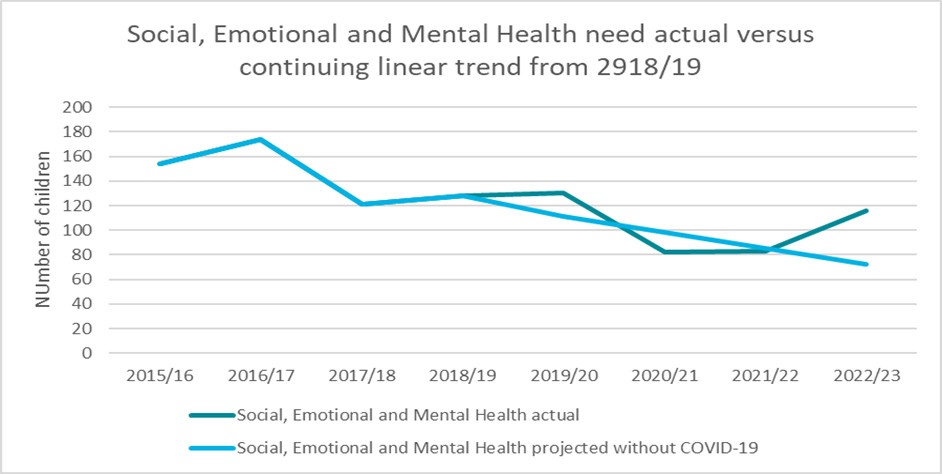
Conversely, after a decline during the COVID-19 restrictions, provisions for Social, Emotional and Mental Health needs saw a sharp increase since 2021/22, resulting in 44 more children receiving SEN provisions than would have been expected had the pre-COVID-19 trend continued.
Figure 13: The Impact of COVID-19 on Social, Emotional and Mental Health need provision in KS1
vfvvf
Key Stage 2 (Years 3-6)
In 2022/23, the number of children identified with SEND at Key Stage 2 in Milton Keynes was 2,872, with 2,237 children receiving SEN Support and 635 with an EHC plan in place. In total 17.8% of pupils in KS2 were identified with SEND, compared to 19.8% in England.
Children with ASD as their primary need accounted for 44.6% of all children with a EHC plan, higher than the proportion for England, which was 32.6%. Speech, Language and Communication was the second largest primary need at 17.6%, lower than England (21.2%), while Social, Emotional and Mental Health needs accounted for another 10.7%, while the proportion for England was 14.9%. The proportion of all school children receiving provisions for Social, Emotional and Mental Health needs is also considerably lower than England. No other primary need accounted for more than 6%.
Table 5: KS2 Percentages and growth of three largest groups with EHC Plans (Milton Keynes and England)
| Primary Need | MK number of children (2022/23) | MK %age of EHC Plans (2022/23) | England %age of EHC Plans (2022/23) | MK %age of all children (SEND and no SEND) (2022/23) | England %age of all children (SEND and no SEND) (2022/23) | MK Rate of change 2015/16- 2022/23 (CAGR) | England rate of change 2015/16- 2022/23 (CAGR) |
|---|---|---|---|---|---|---|---|
| Autistic Spectrum Condition | 283 | 44.6% | 32.6% | 1.8% | 1.4% | 12.5% | 11.7% |
| Speech, Language and Communication | 112 | 17.6% | 21.2% | 0.7% | 0.9% | 17.6% | 12.2% |
| Social, Emotional and Mental Health | 68 | 10.7% | 14.9% | 0.4% | 0.7% | 10.7% | 10.7% |
For children receiving SEND Support, pupils with Moderate Learning Difficulties were the largest cohort, whereas in England the largest group was those whose primary need is Speech, Language and Communications. The number of children receiving provisions with Moderate Learning Difficulties is however declining in line with the England trend. As with EHC plans, the proportion of children with Social, Emotional and Mental Health needs was lower than England overall.
Table 6: KS2 Percentages and growth of three largest groups receiving SEN Support (Milton Keynes and England)
| Primary Need | MK number of children 2022/23 | MK %age of SEN Support 2022/23 | England %age of SEN Support 2022/23 | MK %age of all children (SEND and no SEND) 2022/23 | England %age of all children (SEND and no SEND) 2022/23 | MK Rate of change 2015/16- 2022/23 (CAGR) | England rate of change 2015/16- 2022/23 (CAGR) |
|---|---|---|---|---|---|---|---|
| Moderate Learning Difficulties | 620 | 27.7% | 21.3% | 3.8% | 3.3% | -3.6% | -3.5% |
| Speech, Language and Communication | 612 | 24.7% | 24.8% | 3.8% | 3.8% | 9.1% | 7.1% |
| Social, Emotional and Mental Health | 341 | 15.2% | 20.1% | 2.1% | 3.1% | 5.1% | 4.4% |
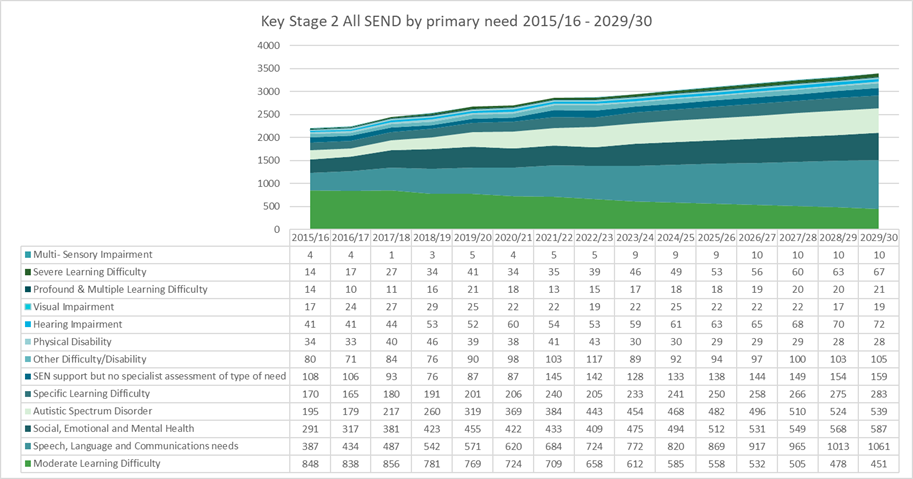
If the trends in primary need provisions were to continue, there would be 529 more children in KS2 receiving SEND provisions by 2029/30, driven by increases in Speech, Language and Communication, ASD and Social, Emotional and Mental Health needs.
Figure 14: Projection of all SEND provision by primary need to 2029/30 in KS2
Impact of COVID-19 restrictions and recovery
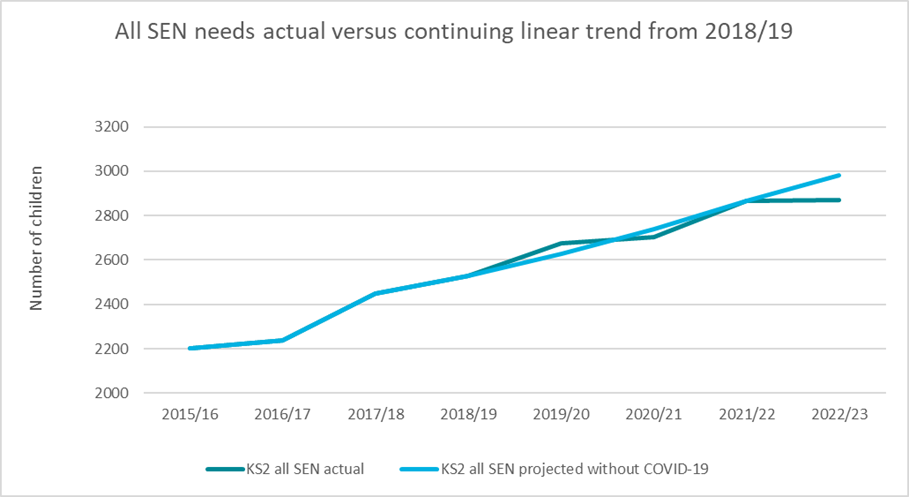
At a high level, COVID-19 and the associated restrictions did not heavily impact on the number of children identified as having SEND in 2019/20-2020/21.
Figure 15: The Impact of COVID-19 on all SEND need provision in KS2
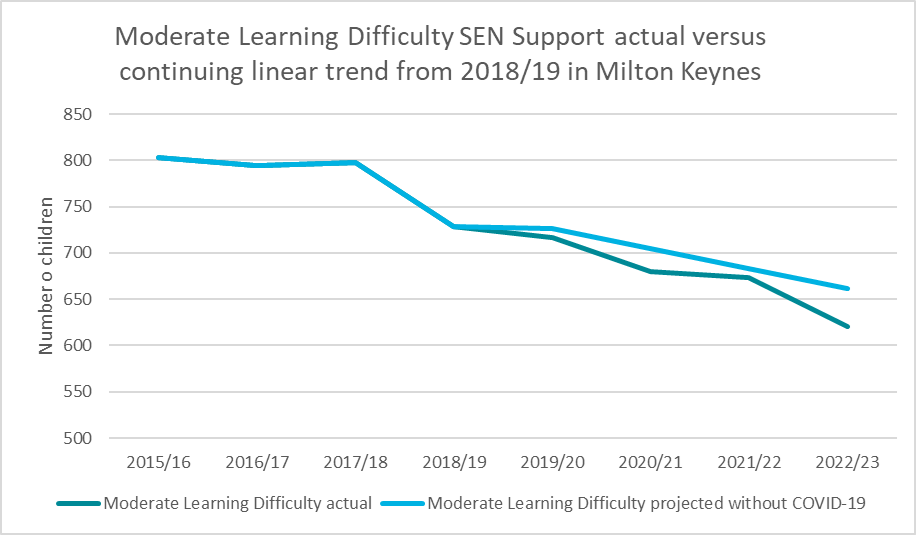
However, the decline in the number of children receiving SEN support for Moderate Learning Difficulties was noticeable during the pandemic and has declined at a faster rate than expected according to the previous trend, leading to a gap of 41 pupils. This suggests that there is a force beyond COVID-19 alone impacting on the number of children being identified with a primary need of Moderate Learning Difficulties.
Figure 16: The Impact of COVID-19 on Moderate Learning Difficulty needs provision in KS2
gbggggggbg
Key Stage 3 (Years 7-9)
In 2022/23, the number of children identified with SEND at Key Stage 3 (KS3) in Milton Keynes was 1,745, with 1,203 children receiving SEN Support and 542 with an EHC plan in place. In total 15.0% of pupils in KS3 were identified with SEND in Milton Keynes, compared to 15.5% in England.
Children with ASD as their primary need accounted for 35.4% of all children with a EHC plan, higher than the proportion for England, which was 30.6% and the number of children receiving EHC plans for ASD has increased at a higher rate than England overall. The number of children receiving EHC plans for Moderate Learning Difficulties in KS3 decreased between 2015/16 and 2022/23, while in England there was a significant positive growth. Speech, Language and Communication was the only other primary need to account for more than 10% of all those receiving EHC plans.
Table 7: KS3 Percentages and growth of the four largest groups with EHC Plans (Milton Keynes and England)
| Primary Need | MK number of children (2022/23) | MK %age of EHC Plans (2022/23) | England %age of EHC Plans (2022/23) | MK %age of all children (SEND and no SEND) (2022/23) | England %age of all children (SEND and no SEND) (2022/23) | MK Rate of change 2015/16- 2022/23 (CAGR) | England rate of change 2015/16- 2022/23 (CAGR) |
|---|---|---|---|---|---|---|---|
| Autistic Spectrum Condition | 192 | 35.4% | 30.6% | 1.7% | 1.6% | 13.5% | 11.3% |
| Social, Emotional and Mental Health | 85 | 15.7% | 19.6% | 0.7% | 1.0% | 4.9% | 10.5% |
| Moderate Learning Difficulties | 68 | 12.5% | 11.5% | 0.6% | 0.6% | -0.2% | 11.7% |
| Speech, Language and Communication | 65 | 12.0% | 14.3% | 0.6% | 0.7%% | 9.2% | 8.7% |
Children with Moderate Learning Difficulties accounted for the largest proportion of those receiving SEN Support (22.9%), which was higher than England (19.1%). The number of children receiving SEN Support for Moderate Learning Difficulties declined faster than England. The second largest cohort receiving SEN Support was those with Specific Learning Difficulties, which was largely in line with England. However, the rates for children with Social, Emotional and Mental Health were much lower than England across all comparators, as in KS2. Speech, Language and Communication and ASD needs were in line with England overall.
Table 8: KS3 Percentages and growth of the five largest groups receiving SEN Support (Milton Keynes and England)
| Primary Need | MK number of children 2022/23 | MK %age of SEN Support 2022/23 | England %age of SEN Support 2022/23 | MK %age of all children (SEND and no SEND) 2022/23 | England %age of all children (SEND and no SEND) 2022/23 | MK Rate of change 2015/16- 2022/23 (CAGR) | England rate of change 2015/16- 2022/23 (CAGR) |
|---|---|---|---|---|---|---|---|
| Moderate Learning Difficulties | 276 | 22.9% | 19.1% | 2.4% | 2.6% | -4.9% | -2.3% |
| Specific Learning Difficulties | 226 | 18.8% | 19.8% | 1.9% | 2.7% | 3.6% | 2.0% |
| Social, Emotional and Mental Health | 205 | 17.0% | 24.4% | 1.8% | 3.3% | 0.3% | 7.5% |
| Speech, Language and Communication | 180 | 15.0% | 12.1% | 1.5% | 1.6% | 15.2% | 7.4% |
| Autistic Spectrum Condition | 164 | 13.6% | 10.3% | 1.4% | 1.4% | 20.3% | 13.4% |
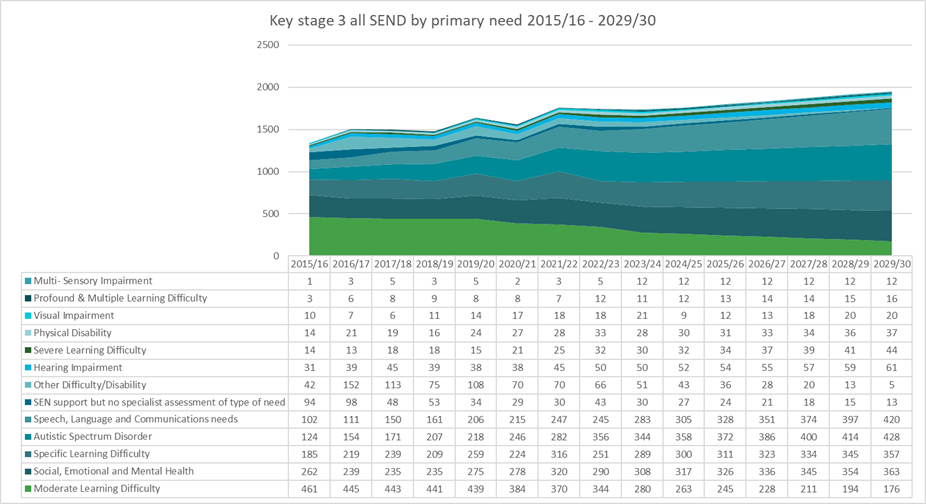
If the trends in primary need provisions were to continue, there would be 216 more children in KS3 receiving SEND provisions by 2029/30, driven by increases in Speech, Language and Communication, ASD and Specific Learning Difficulty needs.
Figure 17: Projection of all SEND provision by primary need to 2029/30 in KS3
Impact of COVID-19 restrictions and recovery
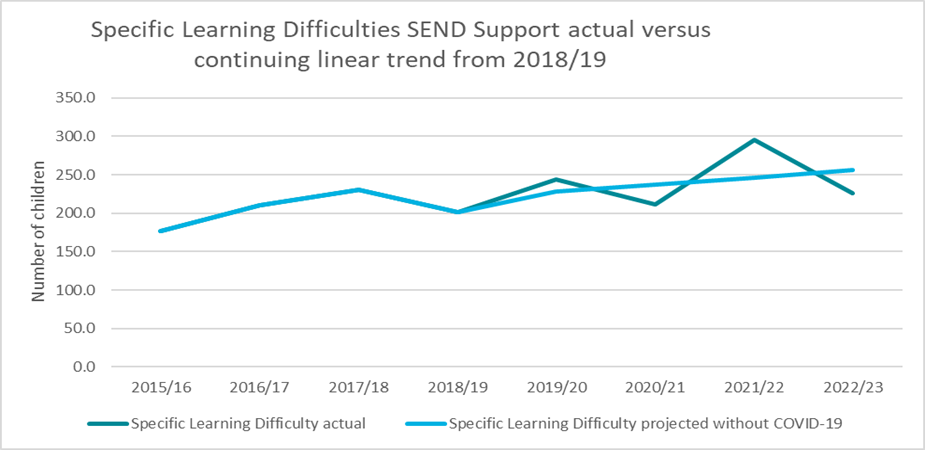
The number of children with EHC plans and receiving SEND support changed markedly in the covid years. The number of children in KS3 with EHC plans rose steadily irrespective of the pandemic, primarily driven by the children with autism. However, there were declines over the COVID-19 period in the number of children identified with Specific Learning Difficulties receiving SEN Support and this has fluctuated considerably since.
Figure 18: The Impact of COVID-19 on Specific Learning Difficulties needs provision in KS3
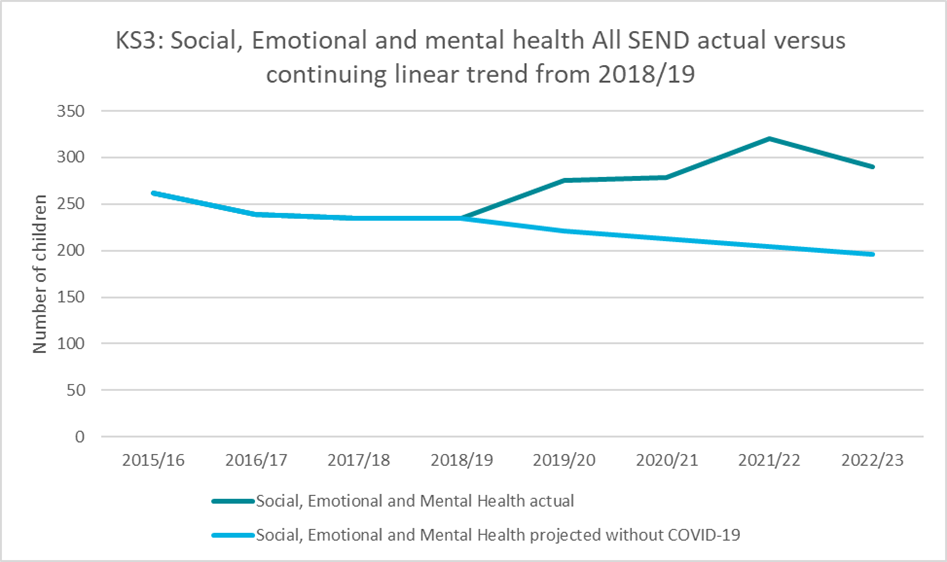
There has been a clear rise in the number of children identified with Social Emotional and Mental Health difficulties at SEN Support since the pandemic. This rise is higher than might have been expected if Covid-19 hadn’t happened, and is in line with anecdotal reports of the impact of restrictions on children’s social development. In 2022/23 there was a drop in the number but it is still well above that which might have been expected.
Figure 19: The Impact of COVID-19 on Social, Emotional and Mental Health needs provision in KS3
thehe
Key Stage 4 (Years 10-11)
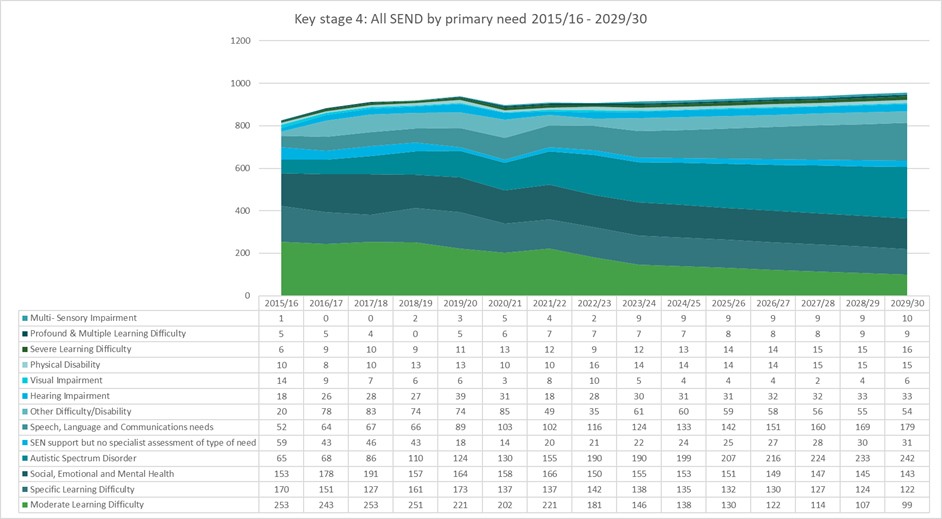
In 2022/23, the number of children identified with SEND at Key Stage 4 (KS4) in Milton Keynes was 907, with 599 children receiving SEN Support and 308 with an EHC plan in place. In total 12.7% of pupils in KS4 were identified with SEND in Milton Keynes, compared to 17.1% in England.
Children with autism as their primary need accounted for the largest proportion of children with an EHC plan, at 34.4%, which was higher than England (29%). The number of children with a primary need of Autism and an EHC plan also grew faster in Milton Keynes than in England from 2015/16 to 2022/23.
However, the rates for children with Social, Emotional and Mental Health were much lower than England across all comparators, as with SEN Support previously. The number of children with EHC plans for Moderate Learning Difficulties in KS3 decreased between 2015/16 and 2022/23 at a faster rate than England overall, while Speech, Language and Communication number in this cohort grew much faster.
Table 9: KS4 Percentages and growth of the four largest groups with EHC Plans (Milton Keynes and England)
| Primary Need | MK number of children (2022/23) | MK %age of EHC Plans (2022/23) | England %age of EHC Plans (2022/23) | MK %age of all children (SEND and no SEND) (2022/23) | England %age of all children (SEND and no SEND) (2022/23) | MK Rate of change 2015/16- 2022/23 (CAGR) | England rate of change 2015/16- 2022/23 (CAGR) |
|---|---|---|---|---|---|---|---|
| Autistic Spectrum Condition | 106 | 34.4% | 29.0% | 1.5% | 1.4% | 11.7% | 9.0% |
| Social, Emotional and Mental Health | 55 | 17.9% | 21.9% | 0.8% | 1.0% | 3.6% | 7.7% |
| Moderate Learning Difficulties | 45 | 14.6% | 12.2% | 0.6% | 0.6% | -3.1% | -1.0% |
| Speech, Language and Communication | 39 | 12.7% | 11.9% | 0.5% | 0.6% | 10.8% | 5.5% |
Children with Moderate Learning Difficulties accounted for the largest proportion of those receiving SEN Support (22.7%), which was again higher than England (17.6%). The number of children receiving SEN Support for Moderate Learning Difficulties is declining faster than England. The second largest cohort receiving SEN Support was those with Specific Learning Difficulties, which declined between 2015/16 and 2022/23 against a gentle increase in growth in England. However, despite this trend, the proportion of children receiving SEN Support identified with Specific Learning Difficulties remains higher than for England overall.
The rates for children with Social, Emotional and Mental Health were much lower than England across all comparators, as in previous key stages. The number of children receiving SEN Support for Speech, Language and Communication needs grew at a higher rate than England overall.
Table 10: KS4 Percentages and growth of the five largest groups receiving SEND Support (Milton Keynes and England)
| Primary Need | MK number of children 2022/23 | MK %age of SEN Support 2022/23 | England %age of SEN Support 2022/23 | MK %age of all children (SEND and no SEND) 2022/23 | England %age of all children (SEND and no SEND) 2022/23 | MK Rate of change 2015/16- 2022/23 (CAGR) | England rate of change 2015/16- 2022/23 (CAGR) |
|---|---|---|---|---|---|---|---|
| Moderate Learning Difficulties | 136 | 22.7% | 17.6% | 1.9% | 2.2% | -5.2% | -1.6% |
| Specific Learning Difficulties | 127 | 21.2% | 23.1% | 1.8% | 2.6% | -3.0% | 1.8% |
| Social, Emotional and Mental Health | 95 | 15.9% | 27.0% | 1.3% | 3.4% | -2.1% | 4.6% |
| Autistic Spectrum Condition | 84 | 14.0% | 10.4% | 1.2% | 1.3% | 26.7% | 13.4% |
| Speech, Language and Communication | 77 | 12.9% | 9.7% | 1.1% | 1.2% | 12.9% | 8.0% |
If the trends in primary need provisions were to continue, there would be 50 more children in KS4 receiving SEND provisions by 2029/30, driven by increases in Speech, Language and Communication, and ASD needs, largely offset by declines in Moderate Learning Difficulties.
Figure 20: Projection of all SEND provision by primary need to 2029/30 in KS4
Impact of COVID-19 restrictions and recovery
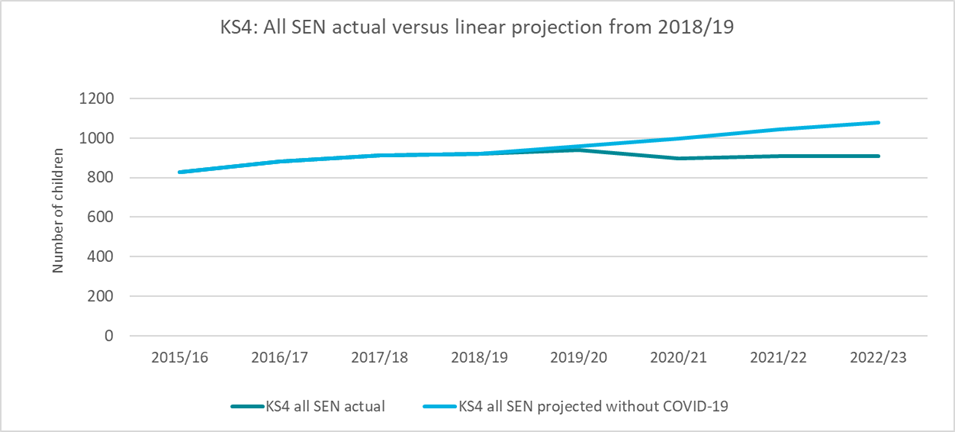
Across all SEN types in KS4, the number of children receiving provision decreased during the COVID-19 period and has stayed at a lower level than would otherwise be expected if the trend to 2018/19 had continued. This equates to a gap of 170 children in 2022/23.
Figure 21: The Impact of COVID-19 on all SEND needs provision in KS4
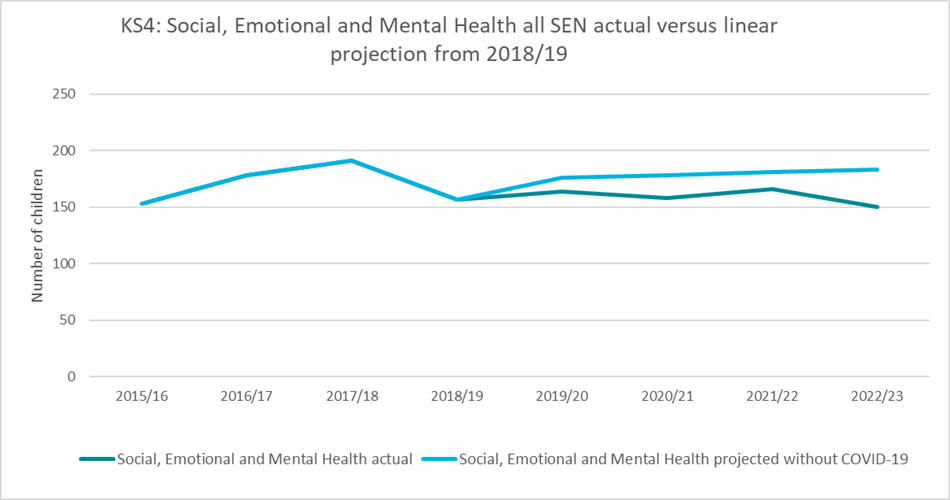
This gap is largely being created by a change in Social, Emotional and Mental Health needs, which levelled off during the COVID-19 period and has dropped again in 2018/19, in contrast to other stages when the need has increased from 2021/22.
Figure 22: The Impact of COVID-19 on Social, Emotional and Mental Health needs provision in KS4
thethe
College Years (Years 12-14) and transition
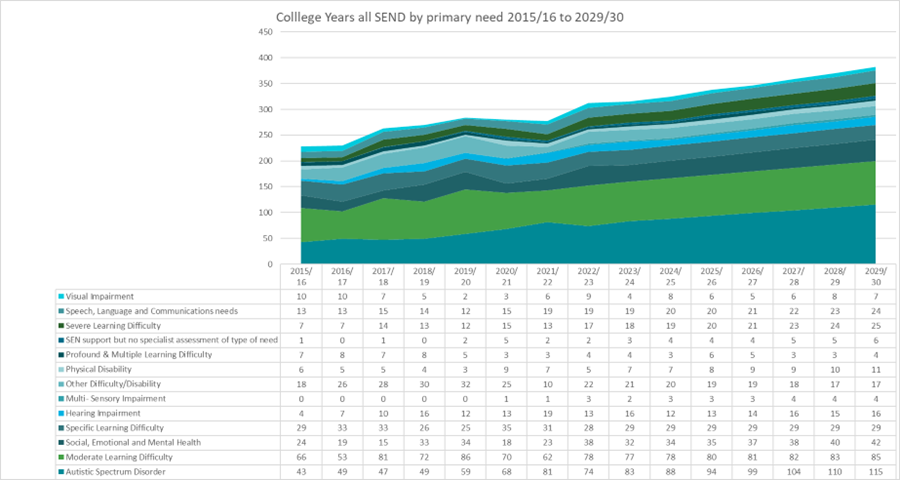
In 2022/23, there were 312 young people receiving SEND provision in years 12 to 14 in Milton Keynes, of whom 154 children received SEN Support and 158 had an EHC plan in place. In total 8.8% of pupils received SEND provision in Milton Keynes in their college years, lower than 11.2% for England overall.
The split between EHC and SEN support was relatively equal and it was noticeable that for both types of provision there was a higher proportion of young people with Moderate Learning Difficulties in Milton Keynes than for England overall. Conversely, there was a noticeably lower proportion of young people receiving SEN support for Specific Learning Difficulties and ASD. This suggests that there was an historic over-identification of moderate learning difficulties instead of ASD and specific learning difficulties.
Table 11: College Years Percentages and growth of the three largest groups with EHC Plans (Milton Keynes and England)
| Primary Need | MK number of children (2022/23) | MK %age of EHC Plans (2022/23) | England %age of EHC Plans (2022/23) | MK %age of all children (SEND and no SEND) (2022/23) | England %age of all children (SEND and no SEND) (2022/23) | MK Rate of change 2015/16- 2022/23 (CAGR) | England rate of change 2015/16- 2022/23 (CAGR) |
|---|---|---|---|---|---|---|---|
| Autistic Spectrum Condition | 50 | 31.6% | 32.2% | 1.4% | 1.6% | 5.7% | 6.1% |
| Moderate Learning Difficulties | 43 | 27.2% | 11.5% | 1.2% | 0.6% | 3.4% | -1.2% |
| Severe Learning Difficulties | 17 | 10.8% | 22.0% | 0.5% | 1.1% | 13.5% | -0.5% |
Table 12: College Years Percentages and growth of the five largest groups receiving SEN Support (Milton Keynes and England)
| Primary Need | MK number of children 2022/23 | MK %age of SEN Support 2022/23 | England %age of SEN Support 2022/23 | MK %age of all children (SEND and no SEND) 2022/23 | England %age of all children (SEND and no SEND) 2022/23 | MK Rate of change 2015/16- 2022/23 (CAGR) | England rate of change 2015/16- 2022/23 (CAGR) |
|---|---|---|---|---|---|---|---|
| Moderate Learning Difficulties | 35 | 22.7% | 10.7% | 1.0% | 0.7% | 1.3% | -2.4% |
| Specific Learning Difficulties | 26 | 16.9% | 27.7% | 0.73% | 1.7% | -0.5% | 2.8% |
| Social, Emotional and Mental Health | 24 | 15.6% | 19.9% | 0.67% | 1.2% | 8.0% | 6.3% |
| Autistic Spectrum Condition | 24 | 15.6% | 14.9% | 0.67% | 0.9% | 15.0% | 13.5% |
If the trends in primary need provisions were to continue, there would be 82 more children in their College Years receiving SEN provisions by 2029/30, driven by increases in ASD and Specific Learning Difficulty needs.
Figure 23: Projection of all SEND provision by primary need to 2029/30 in KS4
Impact of COVID-19 restrictions and recovery
Overall, COVID-19 and the associated restrictions led to leveling off of the increases in overall numbers of young people receiving SEN provisions, which then started to recover from 2021/22 to 2022/23.
Figure 24: The Impact of COVID-19 on all SEND needs provision in College Years
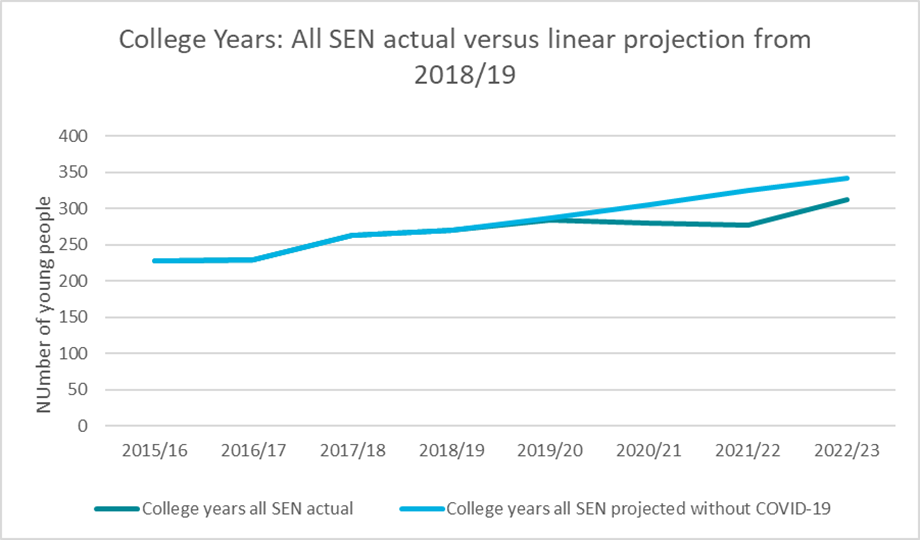
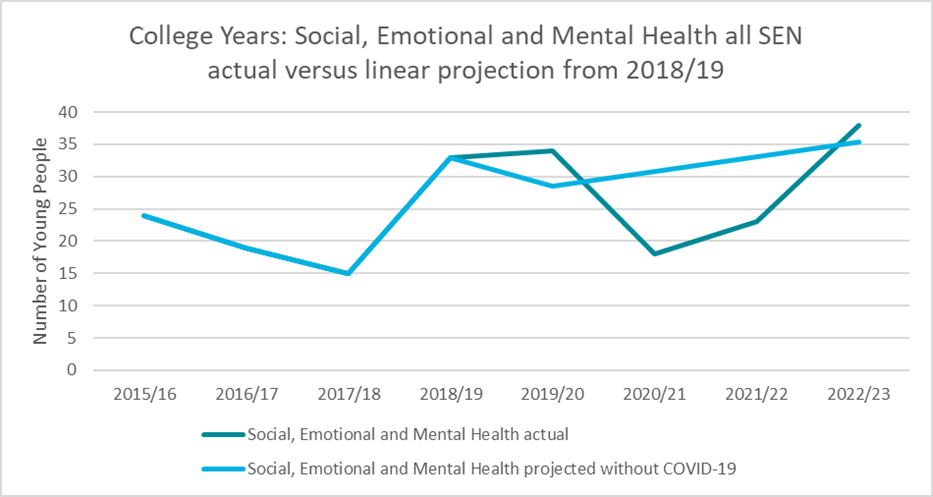
However, other underlying trends of increases in ASD provisions and decreases in those for moderate learning difficulties masked a sharp decline in provisions for social, emotional and mental health during the COVID-19 period and a rise since then above that which would otherwise have been expected.
Figure 25: The Impact of COVID-19 on Social, Emotional and Mental Health needs provision in College Years
Young people not in Education, Employment or Training
In Milton Keynes, overall 4.0% of 16 to 17 years olds were not in education, employment or training in 2022/23, which was lower than England (6.9%). However, the percentage was three time higher (11.9%) for young people with SEND in Milton Keynes and higher than the 10.1% for England overall. Furthermore, fewer young people with SEND stay in education for their college years. Around half of all non-SEND pupils continue education into the college years, whereas for those with SEND, it is about a third.
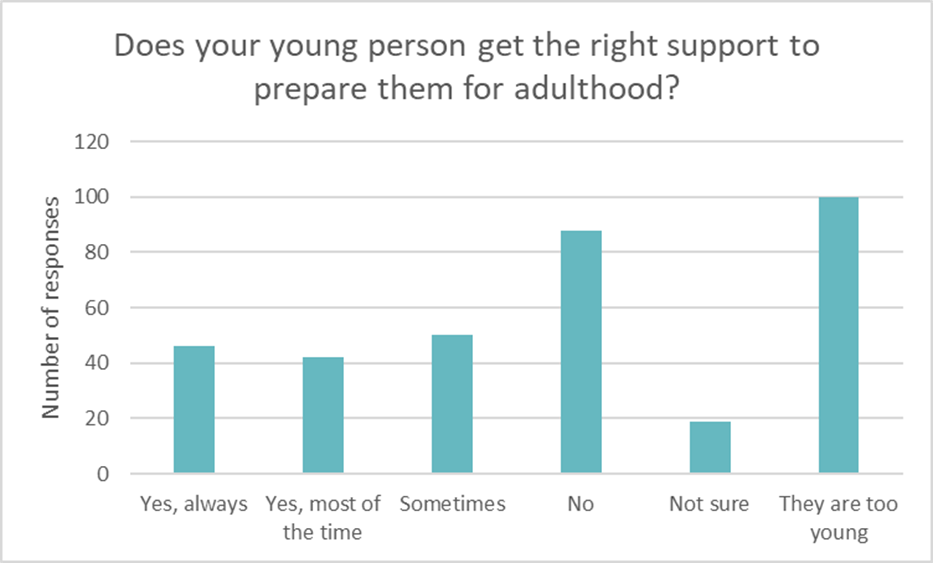
According to the Parents and Carers Alliance 2023 Survey, the same number of parents and carers felt that they got the support needed all or most of the time to prepare their young people for adulthood as felt that they did not get the support necessary.
Figure 26: Parents’ and carers’ views on support received to prepare them for adulthood
ththehe
Secondary need
Not all children’s needs fit under a single heading and secondary needs are identified to help understand demand for more complex provision. Autistic children and young people accounted for the largest number of secondary needs, with 510 additional needs identified for the 1,268 children and young people with autistic spectrum conditions. However, those with severe learning difficulties, profound and multiple learning difficulties and physical disability all had a higher proportion of pupils with secondary needs identified.
Table 13: Number of secondary needs identified per primary need category
| Primary need | Number of pupils with primary need | Number of secondary needs | Percentage secondary needs |
|---|---|---|---|
| Autistic Spectrum Conditions | 1268 | 510 | 40.2% |
| Hearing Impairment | 168 | 36 | 21.4% |
| Moderate Learning Difficulty | 1463 | 323 | 22.1% |
| Multi- Sensory Impairment | 18 | 6 | 33.3% |
| Other Difficulty/Disability | 276 | 66 | 23.9% |
| Physical Disability | 129 | 56 | 43.4% |
| Profound & Multiple Learning Difficulty | 52 | 24 | 46.2% |
| SEN support but no specialist assessment of type of need | 252 | 45 | 17.9% |
| Severe Learning Difficulty | 129 | 71 | 55.0% |
| Social, Emotional and Mental Health | 1043 | 278 | 26.7% |
| Specific Learning Difficulty | 673 | 140 | 20.8% |
| Speech, Language and Communications needs | 1897 | 423 | 22.3% |
| Visual Impairment | 73 | 18 | 24.7% |
| Total | 7441 | 1996 | 26.8% |
The most prevalent secondary need across all primary needs in 2022/23 was speech, language and communication (28%), followed by social, emotional and health needs (18%), moderate learning difficulty (16%) and autistic spectrum condition (12%). These were also the top four primary needs and they represent significant additional pressure on services for these needs.
Table 14: Secondary needs for the four primary need groups with most secondary needs
| Secondary need | Primary need | |||
| Autistic Spectrum Disorder | Moderate Learning Difficulty | Social, Emotional and Mental Health | Speech, Language and Communications needs | |
| Specific Learning Difficulty | 27 | 17 | 21 | 32 |
| Moderate Learning Difficulty | 58 | 0 | 58 | 131 |
| Severe Learning Difficulty | 13 | 2 | 0 | 13 |
| Profound & Multiple Learning Difficulty | 4 | 0 | 0 | 0 |
| Speech, Language and Communications Needs | 184 | 135 | 91 | 0 |
| Social Emotional and Mental Health Needs | 116 | 69 | 0 | 95 |
| Hearing Impairment | 3 | 8 | 2 | 11 |
| Visual Impairment | 7 | 7 | 0 | 3 |
| Multi-Sensory Impairment | 5 | 1 | 1 | 1 |
| Physical Disability | 6 | 8 | 2 | 7 |
| Autistic Spectrum Conditions | 0 | 39 | 68 | 86 |
| Other Difficulty/Disability | 85 | 24 | 30 | 25 |
| SEN support but no specialist assessment of type of need | 2 | 13 | 5 | 19 |
Inequalities
Inequalities, such as deprivation and ethnicity affect the education, health and well-being of children of all ages. These are covered in the Children and Young People section of the Milton Keynes JSNA. However, they can impact on children with SEND even more.
Free School Meals
Across England, pupils with an EHC plan or those requiring SEN support are more likely to be eligible for free school meals (FSM) compared to all pupils and to those with no SEN. In Milton Keynes in 2022/23, 37% of pupils with an EHC plan had free school meals, almost double the 19% of pupils eligible for free school meals with no SEN. This was in line with England where 41% of pupils with EHC had free school meals compared to 21% for pupils with no SEN.
As the percentage of all pupils that are eligible for FSM has increased over time, so has the percentage of children with SEN, maintaining a large gap. However, in Milton Keynes the gap between those pupils with an EHC and those receiving SEN support has closed, although there was a levelling off in the percentage of pupils with SEN support who were eligible for free school meals in 2022/23.
Figure 27: More pupils with SEN in Milton Keynes are eligible for free school meals than those without
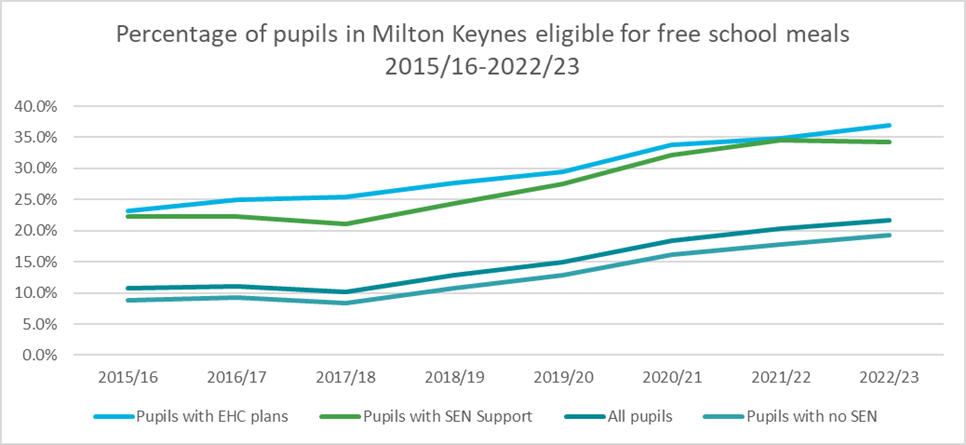
Figure 28: The gap between EHC plans and SEN Support has remained constant in England
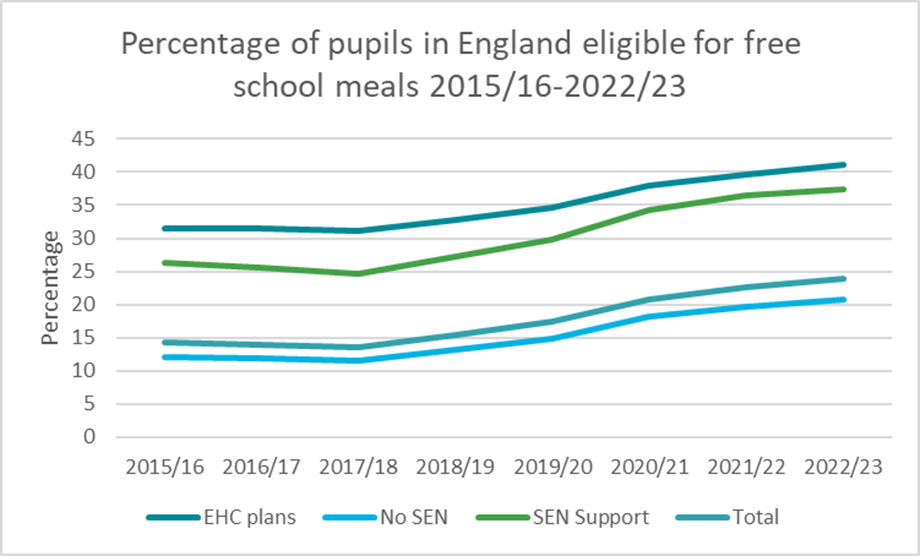
There is also variation in the relationship between eligibility for free school meals and primary need. Across all needs, 35% of pupils receiving SEN provision in Milton Keynes in 2022/23 were eligible for free school meals, lower than the 38% in England overall. In part these elevated levels reflect the additional financial strain associated with children with additional needs.
Figure 29: Eligibility for free school meals varies by primary need but is high across all
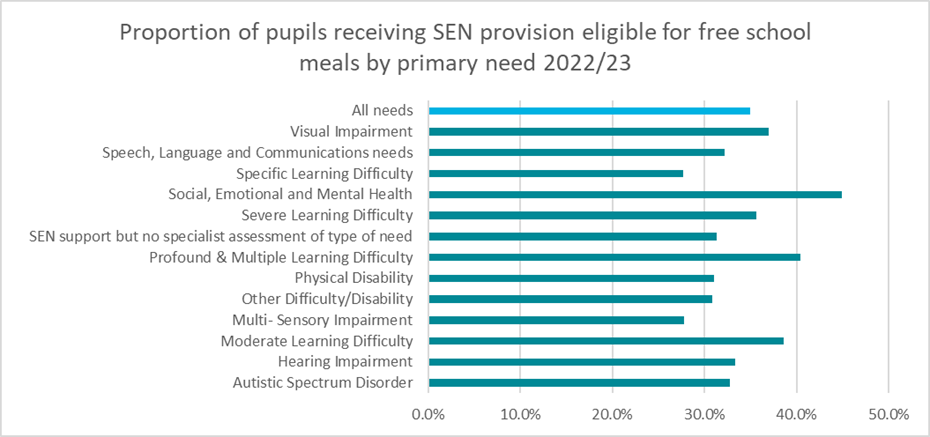
In Milton Keynes, eligibility was highest among those with Social, Emotional and Mental Health needs (44.9%). This was in line with England overall and suggests a relationship between poverty and increased Social, Emotional and Mental Health needs. A 2024 study based on data from the millennium cohort study, identified that children exposed to both persistent poverty and poor caregiver mental health were at markedly increased risk of socioemotional behavioural problems, mental health problems and cognitive disability. It estimated that 40% of socioemotional behavioural problems at the age of 17 were attributable to persistent parental caregivers’ mental health problems and poverty.[4]
Eligibility for free school meals was lowest among those with Specific Learning Difficulties identified as their primary need, in both England (28.2%) and Milton Keynes, where the proportion was 27.6%.
Ethnicity
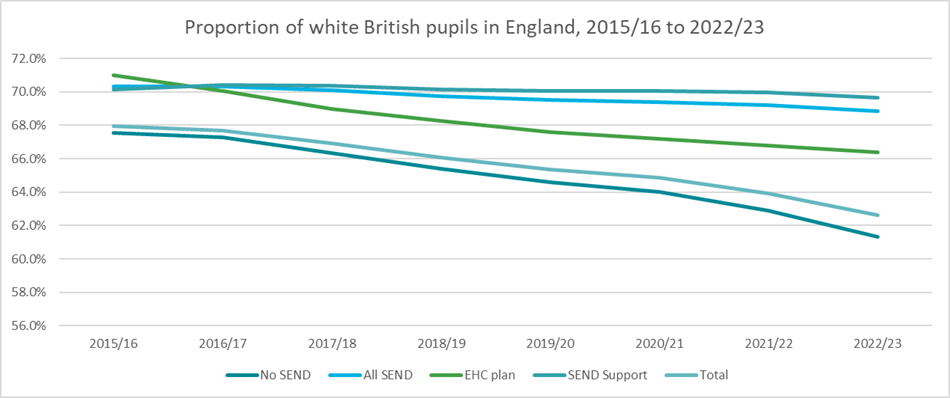
Overall, the proportion of pupils in England’s state-funded schools that is white British has been reducing, falling from 68.0% in 2015/16 to 62.6% in 2022/23. This trend is reflected in the cohort of pupils with EHC plans but starting from a higher proportion (71.0% in 2015/16 to 66.4% in 2022/23). However, the same level of reduction was not seen in pupils receiving SEN Support where the proportion reduced slightly, falling from 70.1% in 2015/16 to 69.7% in 2022/23.
Figure 30: The proportion of white British pupils in England in falling
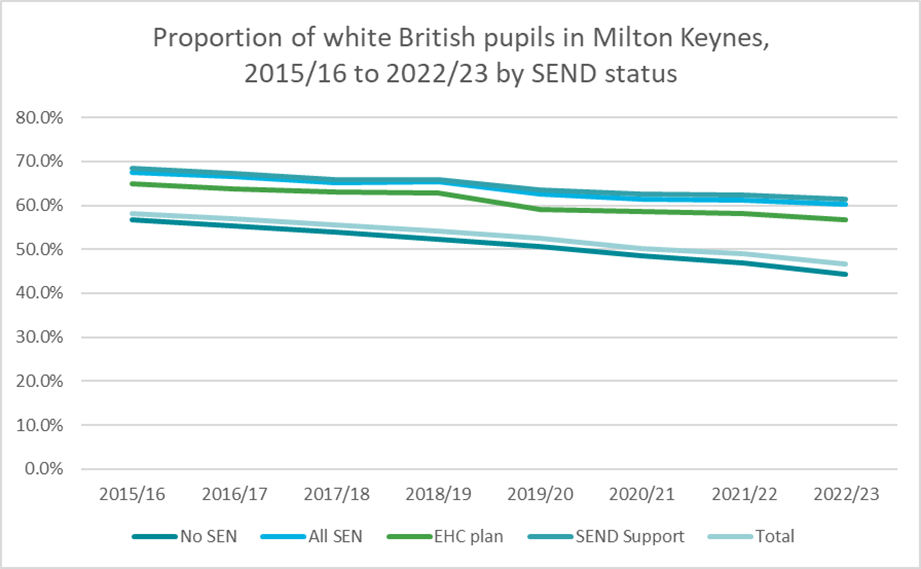
Compared to England, Milton Keynes starts with a lower proportion of pupils who were white British, and that proportion has reduced faster over time. The proportion for all pupils who were white British reduced from 58.2% in 2015/16 to 46.7% in 2022/23. As with England, the slowest change in Milton Keynes was seen in SEND Support, where the proportion of white British reduced from 68.3% to 61.3%. However, this was much closer to the overall rate of reduction than was the case for England overall.
Figure 31: The proportion of white British pupils in Milton Keynes is lower than England
Driving the reduction in the proportion of white British pupils in Milton Keynes is both a decrease in the absolute numbers of white British children and increases in the number of children from ethnic minority groups and specifically from white groups other than British and Irish, Black African and Asian groups, most notably from the Indian group.
Table 15: SEN and Ethnicity in Milton Keynes compared with England, 2022/23
| Ethnic group | Milton Keynes | England | ||
| % of pupils with no SEN | % pupils with SEN | % of pupils with no SEN | % pupils with SEN | |
| White British | 44.4% | 60.1% | 61.3% | 68.8% |
| Black African/Caribbean | 12.8% | 10.7% | 5.3% | 3.0% |
| Indian/Pakistani/Bangladeshi | 11.5% | 7.7% | 10.5% | 7.4% |
| Other White | 10.2% | 6.1% | 7.6% | 5.2% |
| Mixed white and other | 5.6% | 5.4% | 4.1% | 4.3% |
| Other | 6.7% | 4.9% | 5.9% | 6.6% |
| Other Asian | 6.0% | 2.5% | 3.0% | 1.7%% |
| Irish | 0.2% | 0.4% | 0.2% | 0.3% |
| Traveller/Gypsy/Roma | 0.1% | 0.4% | 0.4% | 0.7% |
| Not Known | 2.4% | 1.9% | 1.7% | 1.6% |
Both nationally and in Milton Keynes, there is a higher proportion of white British children among those identified as having SEN than in cohort without SEN. In Milton Keynes there is a higher proportion of children of Black African origin with SEN than nationally and within this group the most often identified primary needs are very different from those for white British. Specifically, there is a greater identification of physical need, such as sensory impairments and speech and language issues, as opposed to specific learning difficulties and social, emotional and mental health needs.
Table 16: Comparison of ranking of primary need proportions for White British and Black African
| Rank of most common primary need | White British | Black African |
| Autistic Spectrum Condition | 9 | 4 |
| Specific Learning Difficulty | 1 | 12 |
| Social, Emotional and Mental Health | 2 | 10 |
| Visual Impairment | 8 | 3 |
| Other Difficulty/Disability | 7 | 8 |
| Moderate Learning Difficulty | 6 | 7 |
| SEN support but no specialist assessment of type of need | 3 | 9 |
| Physical Disability | 5 | 5 |
| Speech, Language and Communications needs | 11 | 2 |
| Profound & Multiple Learning Difficulty | 12 | 6 |
| Multi- Sensory Impairment | 10 | 13 |
| Severe Learning Difficulty | 13 | 1 |
| Hearing Impairment | 4 | 11 |
Further analysis shows also differences by phase of schooling. There were 6,509 pupils in state-funded nursery, primary and secondary schools who received SEND provisions in 2023/23. Whereas 71% of the 2,488 pupils in state-funded secondary school receiving SEND provisions were identified as White British, the proportion was 54% in state-funded primary schools, where 3,991 received SEND provision. The proportion in state-funded nurseries was lower again at 50%, however, there were only 30 children receiving SEND provision. Overall, the proportion of white British children receiving SEND provision was considerably different to that of the general state school populations.
Projections
There are two primary drivers that dictate the number of children receiving SEND provisions. The first is the number of children in school overall and the second is the proportion of those children identified as having SEND.
Children in School
The number of children in Milton Keynes is expected to grow but more slowly than in previous years. Overall the Milton Keynes population increased by 15.4% between the 2011 and 2021 Censuses, the second largest growth in the South East region. This was over and above the level of growth identified in the projections developed by the ONS (9.5%), however, it was in line with the growth in housing in Milton Keynes. Therefore, population forecasts have been developed locally that add a housing element to the established components of population change – births, deaths and migration – to develop a forecast.
According to these locally developed forecasts, the number of children aged under 16 is expected to increase 5% over the 10-year period to 2032/33. Based on the forecasts for all 0- to 19-year-olds and the historic proportions of children in Milton Keynes’ schools by age, it is estimated that the number of school pupils in Milton Keynes’ schools will rise 6.7% over the 10-year period between 2023/24 and 2032/33. This is considerably lower than the 13.8% if the growth from 2015/16 to 2022/23 continued at the same annual rate to 2032/33.
Please note: As with all forecasts, there is a considerable amount of uncertainty and no attempt is made to model factors such as war, future pandemics, government policy on international migration etc., which have impacted on the population of Milton Keynes in the past. The full population forecasts for Milton Keynes can be found here.
Children and Young People in Milton Keynes with SEND
The proportion of school pupils receiving SEN provisions in Milton Keynes has been consistently below that of England as a whole and therefore although the number of children receiving SEN will increase in line with the population, it is also likely that it will increase as more children are identified as requiring SEN provisions.
Building projections
To this point, all projections in this JSNA have been based purely on continuing the changes in provision that had been seen between 2015/16 and 2022/23 for the next seven years. This implicitly includes both changes in population and the proportion of children receiving SEN provision.
Illustrated below are five different scenarios for projecting the future demand for SEN provision in Milton Keynes. The first is based on the continuation of historical trends as has previously been used in this JSNA and the other four use the locally-developed population forecasts with different levels of SEN provision to help identify what might happen to demand in the future.
Figure 32: Future SEND provision demand scenarios
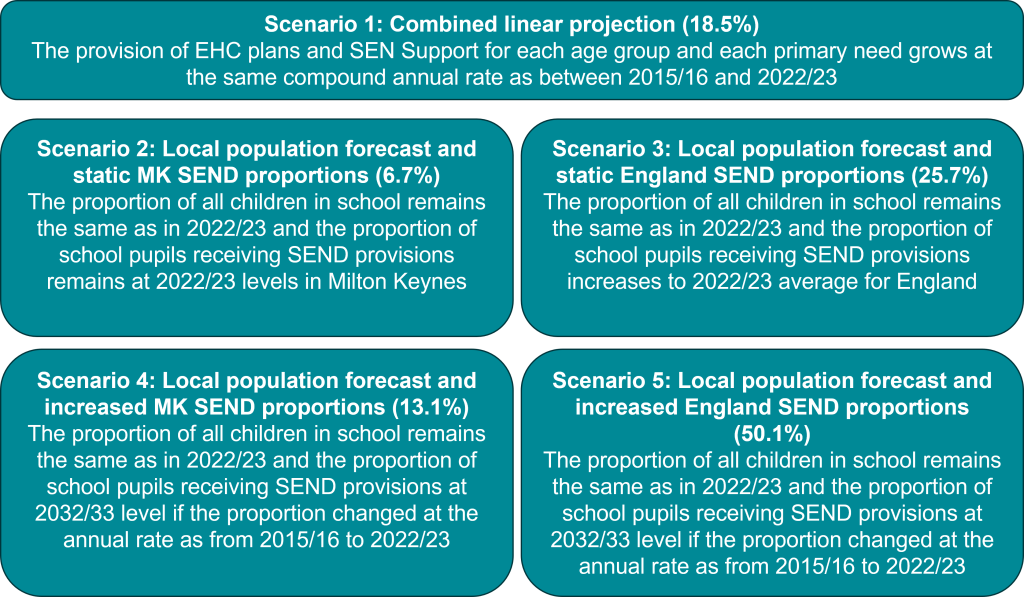
Using these scenarios, the following numbers of pupils receiving SEND provision were projected for five- and ten-years’ time. These show that raising the proportion of pupils receiving SEN provision in Milton Keynes to the national average has the greatest impact on the total numbers, potentially reaching a high 9,947 in 2027/28 and 11,224 by 2032/33.
Figure 33: Projections for SEND provision in 2027/28 under five different scenarios
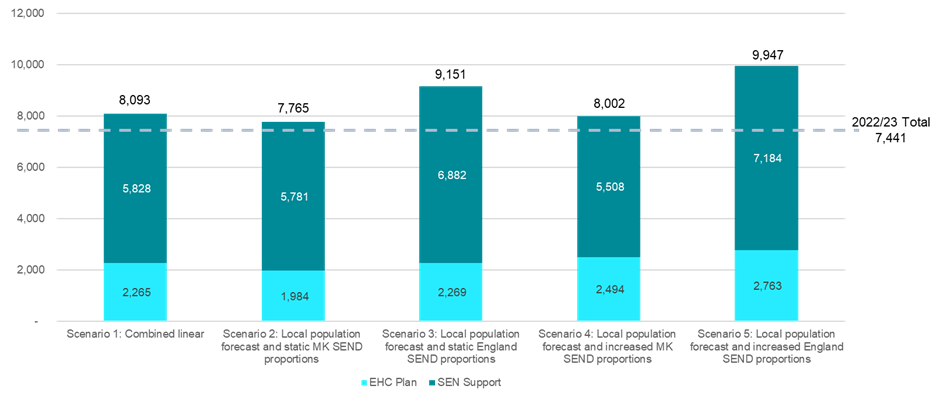
Figure 33 illustrates the different impacts of those scenarios on the number of children projected to be receiving SEND provisions in 2029/30. It shows a range between a low estimate of 8,215 whereby the existing trends for each primary need continue and a high of 11,007 if the overall school population increased at a level that might be expected from a large building programme and the proportion of school children with SEND provisions in Milton Keynes increased to the same level as England.
The local offer
To help people navigate the system, a video explaining SEND provision in Milton Keynes and how to get support, advice and how to access services has been created. It can be view here.
Special Educational Needs in Milton Keynes are identified and addressed through a combination of education, local authority and health services, working together with parents and young people. The ultimate goal is to empower young people with SEND to live well, learn well and lead happy and fulfilled lives.
Identification of SEN
There are multiple points at which children with SEND can be identified and their needs assessed and addressed, from birth right through to the end of their time in education, summarised below.
Table 17: Stages and ages for SEND identification
| Stage | Identification of SEND | SEN service steps & actions |
| Pre-birth | Maternity surveillance & Starting Together programme (start of the 8 stage assessment process including pre-birth Midwifery Health and Social Assessment) | |
| Birth – 3 months | At birth: APGAR score, Newborn hearing screening and vision screening | Referral to sensory support if appropriate |
| New birth visit after 10-14 days by the Health Visitor | Referral to Team Around the Child/8 stage assessment model suite of interventions if appropriate | |
| ASQ3 completed at 3 months with the parent. Early Help Assessment completed if appropriate | ||
| 3 months – 2 years | ASQ3 &SE completed at 9 months with Health Visitor Early Help Assessment completed if appropriate | |
| 2 year progress check carried out by Health Visitor & EY practitioner. Early Help Assessment completed if appropriate | ||
| 2 years – Reception | Assess, plan, do, review cycle as per the Code of Practice, led by the setting and supported by external agencies e.g. Start Well, Ladywood Outreach, Educational Psychology etc. All co-ordinated via the Early Help process | Application for Inclusion Funding or a place in an Early Years High Needs Base or an EHCP needs |
| Baseline assessment on entry to Reception & Foundation Stage Profile at the end of Reception | SEND matrix used to determine whether to refer a CYP for an EHC Needs Assessment | |
| 5 years – 25 years | Early Help Assessment used to involve CYP and parents in the assessment process, identify needs, review progress/provision, refer to appropriate support services and co-ordinate support through a lead professional. | |
| The Assess, Plan, Do, Review Process is used by settings to ensure consistency regarding the assessments, processes, interventions and provision offered to children with SEN/D | ||
| In school tracking of progress through school-based assessments |
Education services
Children who receive SEN Support are taught in mainstream schools, with the exception of a small number (25) who have alternative provision (AP). There is a relatively even split between mainstream and special schools for the education of children with an EHC plan.
Table 18: 2023 SEN provision by year group and school type, 2022/23
| Stage/School Years | EHC plans | SEN support | |||||
| Mainstream | Special | AP | Total | Mainstream | AP | Total | |
| Early years (age 0-2) | 0 | 7 | 0 | 7 | 98 | 0 | 98 |
| Reception (year R) | 34 | 15 | 0 | 49 | 320 | 0 | 320 |
| Key stage 1 (years 1-2) | 158 | 44 | 0 | 202 | 929 | 0 | 929 |
| Key stage 2 (years 3-6) | 358 | 275 | 2 | 635 | 1669 | 2 | 1671 (2237) |
| Key stage 3 (years 7-9) | 273 | 282 | 3 | 542 | 1203 | 0 | 1203 |
| Key stage 4 (years 10-11) | 163 | 142 | 3 | 308 | 598 | 1 | 599 |
| Years 12-14 | 21 | 49 | 13 | 158 | 153 | 1 | 154 |
| Total | 979 | 907 | 21 | 1901 | 5536 | 4 | 5540 |
Special Schools
In 2022/23 1.7% (907) of Milton Keynes’ children and young people are educated in the area’s six state-funded special school. This equates to 47.8% of children and young people with EHC plans, which is well above the England average of 37.9%.
Table 19: Schools providing SEND provision in Milton Keynes by age, year group and specialism
| School | Age range | Year Groups | Specialism |
| Roman Fields | 5 to 11 | 1 to 6 | Social, emotional and mental health needs |
| Slated Row | 4 to 19 | R to 14 | Specific learning difficulties |
| Stephenson Academy | 11 to 19 | 6 to 14 | Social, emotional and mental health needs |
| The Redway | 2 to 19 | N to 14 | Profound and multiple difficulties |
| The Walnuts | 4 to 19 | R to 14 | Social communication needs |
| White Spire | 5 to 19 | 1 to 14 | Specific learning difficulties |
As detailed previously, the population in general, the number of children and the number of children and young people with SEND increased over the last decade and is expected to continue growing. Despite this continued growth across Milton Keynes, the number of special schools has remained the same since 1997.
There have, however, been a number of additions, redesigns and expansions of existing places in line with the school place planning strategy:
- A new Autistic Spectrum Condition provision was built at The Walnuts School, which had previously been sited in Simpson
- A second site of Slated Row School has been developed at Kents Hill Park
- Redway School has developed a transitions department in a separate building
Assessing the capacity of the special school place system is complex. There is no ‘net capacity’ assessment available as there is for the rest of the maintained mainstream system. Instead, conversations have taken place with each of the six special schools to determine the maximum number of children that each school could admit without prejudicing the quality of education. However, there are a growing number of children and young people with education, health and care plans – 1641 in 2015/16, which had increased to 1858 in 2022.
A comprehensive analysis has taken place to ensure that there is clarity around the projected requirements for school places across mainstream, special and enhanced mainstream for children with an Education Health and Care Plan in Milton Keynes
The driver for this was to ensure that as many children with EHC plans as possible can have their needs met in local mainstream and special provision. As a result of this analysis and projected increase in demand there are five clear proposals which were consulted upon to address these needs are which are being progressed:
- The development of a new primary and a new secondary complex needs school with a specialism in Autistic Spectrum Condition (ASC)
- The development of additional Social, Emotional and Mental Health (SEMH) places at existing SEMH schools
- The development of a high complex needs provision
- The review and development of a communication and interaction resources provision
- The development of additional options for post 16/18 provision
Alongside this work there is a continued focus on inclusion of SEN children within mainstream schools that is vital in ensuring the right place is available for children and young people with the most complex needs.
Exclusions and Suspensions
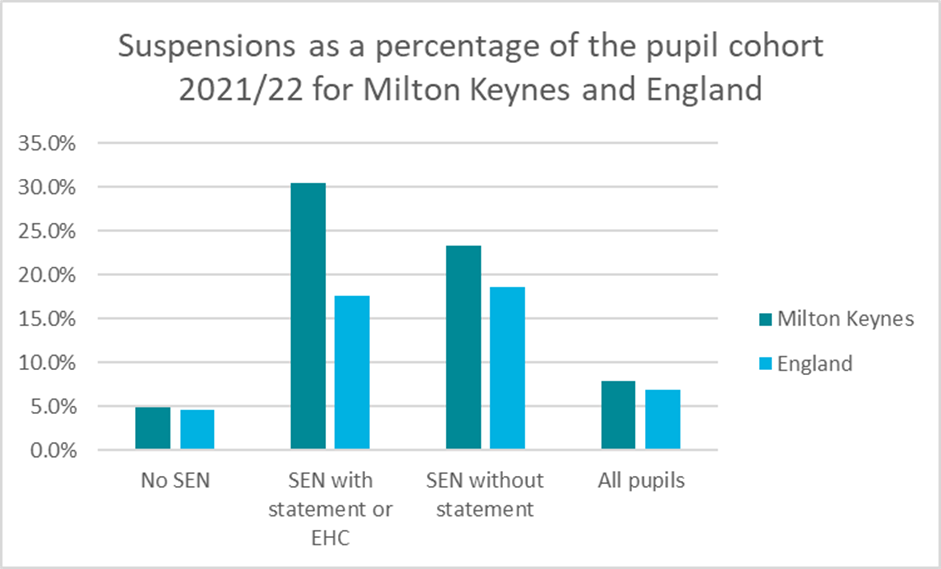
Since 2016/17, the number of permanent exclusions from school of pupils receiving SEN provisions has steadily decreased and there were no permanent exclusions in 2020/21 and 2021/22, the last two years reported. This was in line with the trend for pupils without SEND in Milton Keynes, among whom there were also no permanent exclusions. However, the number of suspensions among pupils with SEND in Milton Keynes in 2021/22 was unusually high, rising from 880 suspensions in 2020/21 to 2,693 in 2021/22. This change was not reflected in the non-SEN school population in Milton Keynes, nor in England overall.
Figure 34: Suspensions unusually high in Milton Keynes SEN cohort in 2021/22
Parent and carer views on health and social care
Overall, parents and carers in Milton Keynes rates the local SEND provision at 3.01 out of 5 in the 2023 SEND Services Survey of over 350 parents and carers conducted by the Parents and Carers Alliance MK.
However, there are variations across the different areas of SEND support. Education services are seen as being more known, more engaged with and more responsive to parents/carers and young people than health services and health services more than social care.
The differences in the experiences of parents and carers in health, social care compared to education are illustrated below:
Figure 35: Parent and carers experiences of services for children with SEND
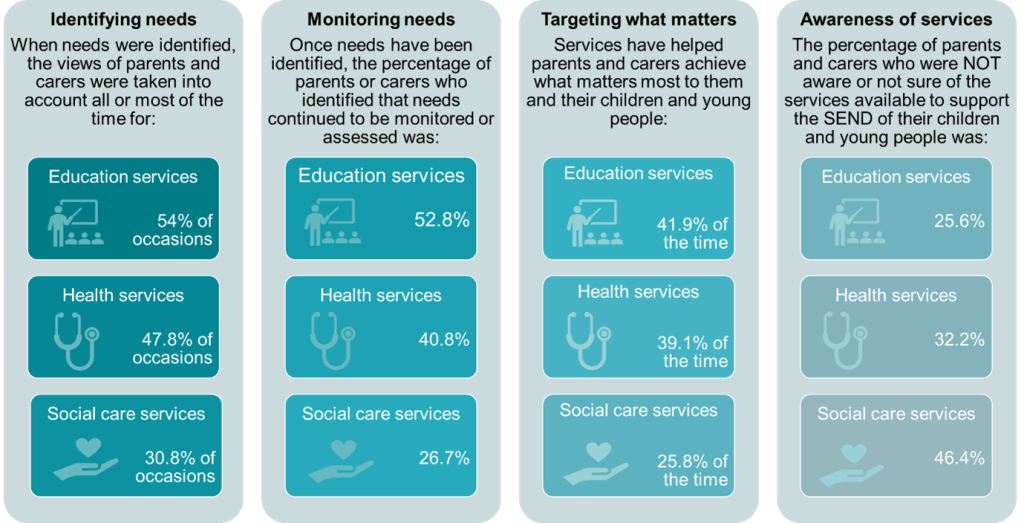
The greatest frustrations with health services centre around access to services, with difficulties in getting appointments and long waiting times. Mental health in general and CAMHS (Child and Adolescent Mental Health Services specifically were areas where parents and carers felt support from health services could be better. Better support was the overall theme for social care services, with a particular emphasis on support for parents and families.
Priorities for action
The Milton Keynes SEND Strategy 2021-25 established five priorities that its future actions will support and the relevance of these to the needs of children and young people with SEN is explained below.
Inclusion
The overall number of children and young people being educated in Milton Keynes has been growing and is expected to continue to grow in line with population growth. With this population growth, the overall number of children and young people with SEND across all need groups can be expected to grow, which means that all services (schools, health services, education support services, social care services and the voluntary and community sector) can expect to see increasing levels of referrals and higher numbers of children requiring some form of adjustments in order for their needs to be met.
Emotional and Social Wellbeing and Mental Health
The number of children and young people receiving SEND provisions with Social, Emotional and Mental Health issues identified as their primary need has been steadily increasing both nationally and in Milton Keynes. In addition, there has been a marked increase in the number of pupils with Social, Emotional and Mental Health issues as a primary need since the COVID-19 pandemic. Across all age groups, with the exception of Key Stage 4, the increase in need was above that which would have been expected had the pandemic not happened, putting additional pressure on resources.
Complex Needs and Specialist Provision
While the majority of this JSNA analysis is based on primary need, it is recognised that many children and young people with SEND have multiple needs, many of which require specialist provision. For example, there is a considerable cohort with autism and another need such as learning difficulties, which require different types of specialist support. Overall, the majority of SEN provision is delivered in mainstream school, however, 47.8% of pupils in Milton Keynes who have EHC plans in place are educated in Special Schools, well above the England average of 37.9%. Despite this the number of special schools has remained the same since 1997 and additional provision has been delivered through additions, and expansion of existing Special Schools.
Transitions and Preparing for the future
The transition into adulthood is a difficult period for most people, but can be especially so for young people with SEN. The number of young people with SEN who are in education post Key Stage 4 (KS4) is small, around 150 per year. This equates to about 17% of the KS4 cohort, whereas the figure for the total school population is around 50%. 11.9% of young people with SEN were not in education, employment or training (NEET) in 2022/23 in Milton Keynes, higher than the England average of 10.1%. This is despite the overall percentage of young people in Milton Keynes not in education, employment or training (4.0%) being lower than the England average of 6.9%. Furthermore, while 40% of respondents to the Milton Keynes Parents and Carers Alliance Survey in 2023 felt their young person received the right support to prepare them for adulthood at least some of the time, a quarter of respondents identified that the right support was not provided.
Autism
Across all age groups, 17% of children and young people with SEN provision had autism identified as their primary need in 2022/23, making it the third most prevalent need. However, that figure rose to 39% of children and young people with EHC plans, meaning autism was the most common primary need amongst this cohort, higher than the England average of 32%. The number of children and young people with autism as a primary need in Milton Keynes has also increased at a double-digit rate from 2015/16 to 2022/23. Furthermore, there has been a noticeable impact from the COVID-19 pandemic on the number of children with Autism identified as their primary need in Key stage 1. Had the increasing trend from 2015/16 to 2018/19 continued to 2022/23 an additional 80 pupils would have been identified with autism as their primary need in 2022/23 than actually occurred.
Priorities, activities and monitoring for 2024
Workstreams have been established for each of the priority areas, led by steering groups and reporting to the SEND Strategic Partnership Board. They have laid out plans for 2024/5 academic year that clearly state:
- What they are working on - top-level objectives. Many of these describe areas that are expected to be worked on for several years to bring continuous change and improvement for families.
- Activities for this year - examples of the specific activities and projects that are taking place within this academic year.
- How success will be measured – examples of the things that will be measured to ensure that work is making a difference to families.
The 2024 Action Plans can be read and downloaded here.
Report Development Team
This report was developed for Marie Denny, Head of Education Sufficiency and Access, Milton Keynes Council, through a multidisciplinary team representing the Children and Young People Teams in Public Health, Education and Social Care in Milton Keynes City Council, the SEND team in BLMK ICS and the Milton Keynes Parents and Carers Alliance. Data analysis and editorial oversight was provided by Catherine Haslam, practitioner in the Public Health Evidence and Intelligence team.
References
[1] Department of Education, 2015
[2] The Compound Annual Growth Rate is the average increase per year over a number of years. It provides a more useful measure of change in numbers than simply measuring the change from the first year to the last as it reflects how each year’s change impacts on those that follow.
[3] O’Nions, E, Petersen, I, Buckman J,E,J, Charlton, R. 2023. Autism in England: assessing underdiagnosis in a population-based cohort study of prospectively collected primary care data, The Lancet Europe, 23, DOI:https://doi.org/10.1016/j.lanepe.2023.100626
[4] Adjei, N,K, Schluter, D, K, Melis, G, Straatmann, V, S, Fleming, K, M, Wicham, S et al (2024), Impact of Parental Mental Health and Poverty on the Health of the Next Generation: A Multi-Trajectory Analysis Using the UK Millennium Cohort Study, Journal of Adolescent Health, 74 (1), 60-70. https://doi.org/10.1016/j.jadohealth.2023.07.029.